Saturday, January 5, 2013

Beware Of These Upcoming Seasonal Patterns In Treasury Bonds And Gasoline


Disclosure: I have no positions in any stocks mentioned, and no plans to initiate any positions within the next 72 hours. (More...)
Our article on "Turnaround Tuesday" documented that weekly seasonality has existed in S&P 500 prices, and that this seasonality (while never constant or fixed) can be a useful secondary tool for practical traders. In fact, this "turnaround Tuesday" pattern was just one example of how seasonal market tendencies can be incorporated into trading strategies.
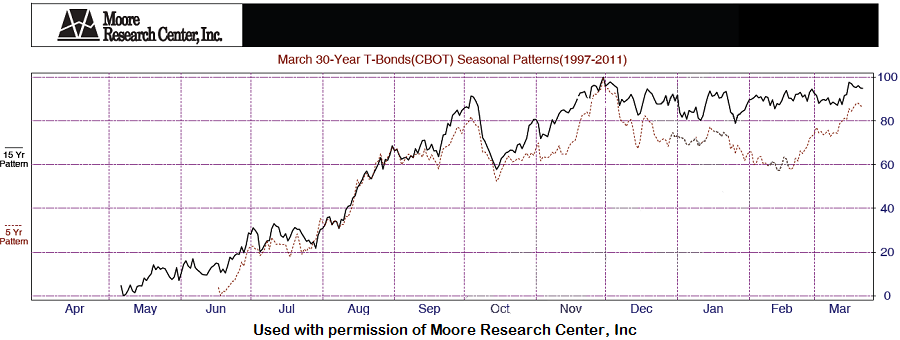
One seasonal pattern that I have been keeping track of and trading for 10+ years is an annual pattern that has existed in long-term bond prices. I have tracked and traded this pattern using the 30 year Treasury bond futures contract, however it has also been valid for trading the Ishares 20+ year Treasury bond ETF (TLT).
My research indicates that the ideal time to short treasury bond futures (or trade with a short bias) has been mid to late January, and the ideal time to cover the short has been late April to early May. The ideal time to get long is Late April to early May, with an exit near the end of the year. This is not all that different from when I first evaluated this pattern 10 years ago. On average, the long side of this seasonal pattern has been a much more powerful trading opportunity than the short side.
The following is a graphical representation of the seasonal tendency in 30 year bond prices and is used with the permission of Moore Research Center, Inc.
(click to enlarge)
Evaluating this pattern using the iShares 20+ year Treasury bond ETF returns slightly different bullish vs. bearish periods. My analysis indicates that the ideal period to get short or sell has been mid-December to early January, while the ideal period to get long or buy has been from early April to early May.
Seasonal tendencies exist in other markets as well. For example, the June Gasoline futures contract has had an inordinate tendency to rise from mid-January to Late March. Moore Research Center, Inc. research indicates that over the past 15 years, the June Gasoline contract has been up 100% of the time between January 13th and March 27th. If you would like to see the historic results for this pattern as outlined by MRCI, click here.
As most Seeking Alpha readers are primarily interested in stocks, I wanted to see if this pattern has worked on the United States Gasoline Fund, LP (UGA) over its more limited trading history. Over the past four years, the pattern has worked 100% of the time, and the average gain was 4.84 points. (Note: On days where the exact strategy date was not a trading day, I used the next trading day's closing price).
Contango and backwardation relationships are very important to the long term returns of both commodity futures contracts and commodity ETFs. If you are not familiar with these concepts, this article will get you up to speed. Forward curve relationships are an additional factor that can be used in conjunction with seasonal patterns.
While I would never trade a seasonal pattern blindly or as a stand-alone strategy, I think they can make good secondary indicators or predictive factors. In the case of this bond seasonal trade, I always combine the seasonal idea with my price-based trading strategies.
Will this Treasury Bond pattern continue to work in the future?
Treasury bond yields have been declining for around 30 years, which has fueled a massive, secular bull market in bond prices. Is the seasonal pattern mentioned above simply a manifestation of this ultra-long term bull market? This is something to consider, as rates are so low now it hard to believe that this bull market could possibly have much further to go.
I am convinced that over the next 20-30 years, long-term government bonds will be a terrible investment. My viewpoint is that rates will begin a long term uptrend (and bond prices a downtrend) when the Federal Reserve sees that nominal rates can rise while still maintaining negative real yields.
From this perspective, the key to understanding the future of fixed income is that the government needs negative real yields in order to "pay for" its outstanding debts. The "fiscal cliff" and "debt ceiling" debates make it clear that the debt problem is not solvable via the democratic process. As a result, the solution to the debt crisis will be left to the machinations of the Federal Reserve and the Treasury Department.
A shift to a long term secular uptrend in rates (downtrend in bonds) might cause a shift in this market's seasonal tendencies. As a result, the relationships mentioned in this article must be monitored as underlying interest rate conditions change.
Additional disclosure: I have an economic relationship with Moore Research Inc. and use their material with written permission. Note that the Bond seasonal pattern dates identified in this article are drawn from my own research.

Friday, January 4, 2013

Hot Sectors for Investing in 2013

7 Hot Sectors For Investing In The New Year

January 4th, 2013


 0
share0
Larry D. Spears: If you’re planning on investing in 2013, economic uncertainty probably will be a factor in deciding where to put your money – but some sectors stand out as solid prospects regardless of the economic climate.
Here’s a breakdown of the best sectors for your money in the New Year.
Hot Sectors for Investing in 2013
 

Silver: With economic uncertainty expected for the near term, gold is typically considered the best hedging choice.
But, as Money Morning Global Resources Specialist Peter Krauth pointed out in his 2013 silver price forecast, silver actually provides more potential for appreciation – and at a far better starting price.
Krauth says the white metal, currently selling for around $30 an ounce, could move to a new high of $54 an ounce in 2013 – and not just because of its hedging value.
Investment demand for silver should continue to increase, driven by the creation and expansion of several silver-backed exchange-traded funds (ETFs) and increased minting of silver coins.
Industrial use of silver is expected to grow even faster. That’s largely due to the use of silver in solar panel manufacturing, which consumed 60 million ounces in 2012.
Solar panel usage is expected to grow as a result of U.S. President Barack Obama’s emphasis on alternative energy and increased demand from Japan, which has made a major shift away from nuclear power in the wake of the Fukushima nuclear power plant disaster.
Consumer staples: Even if the U.S. economy plunges back into a recession, consumer staples like food, beverages and household items will make for good defensive plays.
And if we avoid a recession, Americans will have more money available for discretionary consumer spending. That would translate to more sales of higher-end luxury goods sold by many of the same companies that carry staples.
Whatever happens with the economy, there’s little downside and plenty of growth potential for consumer staples.
But be aware margins in this sector are thin, so focus on companies with good management and effective cost controls when investing in 2013.
Meat: Many food companies have already had to raise product prices in response to the 2012 drought, one of the worst on record.
But meat prices actually fell during the summer and fall as ranchers chose to slaughter more cattle rather than pay soaring prices for feed to replace parched pastureland.
This created a shortage of breeding stock and reduced herd sizes across the board – which, given the long growth cycle (about 15 months), could result in lowered supply for several years to come, sending prices sharply higher in the year ahead. (Hog prices also fell, but not as much, as the shorter pig-breeding cycle allows for faster regeneration of herds, so potential gains there won’t be as large.)
Housing: Analysts have been predicting a U.S. housing rebound since 2009, and they may have finally been proved at least partially correct in the second half of 2012.
The National Association of Home Builders reported year-over-year housing construction was up 42% in October, and the government said seasonally adjusted housing starts rose to an annualized level of 861,000 in November, up from 708,000 in November 2011 and just 555,000 in 2010.
That sounds encouraging, and homebuilder stocks have responded well, but that’s been in large part due to continued caution on the part of the builders.
They haven’t increased hiring to levels proportionate with the increase in construction, the U.S. Bureau of Labor Statistics reports, nor has there been a corresponding rise in building permits.
Still, if the economy doesn’t backslide, pent-up demand due to tight mortgage lending could spark a new 2013 surge in homebuilder activity – and profits.
One caveat: If an eventual fiscal-cliff deal results in an elimination or even reduction in the deduction for home mortgage interest, all bets are off, as residential real estate markets could collapse again.
Hospital operators: With President Obama’s re-election and the Democrats retaining control of the Senate, there now seems little possibility that provisions of Obamacare - formally known as the Patient Protection and Affordable Care Act – will be scaled back.
And that’s particularly good news for the major players in this sector.
The new law mandates health coverage for millions of previously uninsured individuals, including an estimated 7 million with pre-existing conditions. That, in turn, will significantly reduce costs for emergency services at hospitals, which formerly had to treat patients even if they couldn’t pay.
Hospital margins and earnings could also improve because of increased revenue from people who had previously avoided healthcare because of the cost, but will now have insurance to cover care.
Benefits of Obamacare could also spread to some pharmaceutical companies, thanks to improved prescription coverage.
But beware of medical companies that depend heavily on government research or specialized-treatment grants. The National Institutes of Health is already cutting back on funding for many laboratories by 10% or more in the face of the uncertainty over the fiscal cliff.
Coal: This one might seem a counterintuitive pick for investing in 2013, given that President Obama dislikes coal-fired plants even more than he supports alternative-energy production.
But beyond U.S. borders, demand for coal is growing almost everywhere, even in wind- and solar-friendly Europe, where Germany is following Japan in phasing out nuclear power.
Increasing energy demand in emerging countries, particularly China and India, should also help boost coal consumption.
The International Energy Agency (IEA) recently issued a report predicting coal usage will grow by 1.2 billion metric tons a year, closing in on oil as the world’s top energy source by 2017.
Such demand will surely boost prices, as U.S. coal is increasingly sold through the export markets.
Foreign stocks: Although the United States still has the world’s dominant economy, the rest of the world is catching up fast.
As Money Morning Chief Investment Strategist Keith Fitz-Gerald is fond of noting, if you ignore foreign markets, you’re forfeiting two-thirds of global opportunities.
And regardless of what happens with the U.S. economy, the economies of many other countries will undoubtedly grow faster than that of the United States in 2013, so it makes sense for U.S. investors to look abroad as well as to Wall Street.
However, that doesn’t mean you should just blindly throw money at foreign stocks when investing in 2013.
Instead, focus on countries that are encouraging the growth of private enterprise. Look for those that have quality securities laws in place, favorable tax rates for investors and leaders committed to maintaining a strong currency and keeping inflation in check.
Putting at least some of your cash in foreign stocks should offer good chances of a better payoff than many domestic investments.
Investing in 2013: Don’t Overlook Funds, Especially ETFs
I’ve focused on broad categories rather than specific companies because every top sector will have some weak companies, and there will also be a few winners in even the worst sectors.
So if sorting out the cream of the crop in any of these sectors seems too big a challenge, don’t hesitate to focus on funds, particularly industry-specific ETFs.
Funds now cover each of the sectors above – some sectors are covered by several funds – and most offer a valuable combination of targeted potential and defensive diversification for those investing in 2013.
Related Tickers: iShares Silver ETF (NYSEARCA:SLV), Consumer Staples Select Sector ETF (NYSEARCA:XLP), PowerShares DB Agriculture Fund (NYSEARCA:DBA), iShares Dow Jones US Real Estate (NYSEARCA:IYR), iShares Dow Jones US Healthcare (NYSEARCA:IYH), Market Vectors-Coal ETF (NYSEARCA:KOL), iShares MSCI Emerging Markets Index (NYSEARCA:EEM).

Thursday, January 3, 2013

China Poised for 2013 Rebound as Debt Risks Rise for Xi

Play
China May Face Rising Debt Risks in 2013
Incoming President Xi Jinping may find China’s investment-driven economic recovery in the Year of the Snake jeopardized by mounting risks in the finance industry.
Enlarge image

China Poised for 2013 Rebound as Debt Risks Rise for Leader Xi

Wang Ang Zhao/AFP/Getty Images
A store greeter dressed up as God of Wealth stands outside a shop to attract customers in Beijing, China. An economic rebound for China may be a danger that lulls policy makers into complacency, delaying market-driven changes needed to reduce dependence on investment for growth.
A store greeter dressed up as God of Wealth stands outside a shop to attract customers in Beijing, China. An economic rebound for China may be a danger that lulls policy makers into complacency, delaying market-driven changes needed to reduce dependence on investment for growth. Photographer: Wang Ang Zhao/AFP/Getty Images
Enlarge image

China Poised for 2013 Rebound as Debt Risks Rise for Leader Xi

Tomohiro Ohsumi/Bloomberg
Signs of China's economic recovery are popping up in areas from housing to factories to markets. The value of home sales rose 18 percent in November from October and industrial production and retail sales both increased at the fastest clip since March.
Signs of China's economic recovery are popping up in areas from housing to factories to markets. The value of home sales rose 18 percent in November from October and industrial production and retail sales both increased at the fastest clip since March. Photographer: Tomohiro Ohsumi/Bloomberg
Gross domestic product is poised to expand 8.1 percent this year, up from 7.7 percent in 2012, according to the median estimate of economists surveyed last month by Bloomberg News. At the same time, an increase in lending fueled by trust companies and underground banks enhances the risk of loan defaults that would be “severely damaging” to the economy, Standard Chartered Plc says.
The danger is that an economic rebound lulls policy makers into complacency, delaying market-driven changes needed to reduce dependence on investment for growth. Xi needs to rev up consumption and services and ensure credit is diverted from inefficient state enterprises to growth-generating private companies, said David Loevinger, former senior coordinator for China affairs at the U.S. Treasury Department.
“If China tries to sustain growth by adding debt and investing it inefficiently it will be like cotton candy: a short-term high with no lasting value,” said Loevinger, now an Asia analyst in Los Angeles at TCW Group Inc., which oversees about $135 billion. “The U.S. got into trouble because institutions like Fannie Mae (FNMA) and Freddie Mac were too big to fail and had a toxic mix of private shareholders and implicit government guarantees. China’s financial system is full of Freddies and Fannies.”
Fannie Mae and Freddie Mac (FMCC) are the U.S. mortgage financiers that have been under U.S. government conservatorship since 2008, after losses on soured loans pushed them to the brink of insolvency.

More Leverage

Xi and his team are inheriting an economy more leveraged than the one President Hu Jintao took over in 2003. Government, corporate and consumer debt rose last year by 15 percentage points to an estimated 206 percent of GDP, Standard Chartered said in a November report. In March 2003 it stood at 150 percent.
Borrowers are using some new loans to “plaster over non- performing credits” while so-called shadow banking is growing too fast, said economists led by Stephen Green. They estimated that a bad-loan ratio of 12 percent would erase the banking industry’s 7.5 trillion yuan ($1.2 trillion) in capital.
Lending by so-called trust companies surged five times to 1.04 trillion yuan in the first 11 months compared with the whole of 2011. A “large part” of the sector’s lending is to higher-risk entities including local government investment vehicles and property developers that don’t have access to bank loans, the International Monetary Fund said in its Global Financial Stability Report in October.

‘Extremely Reluctant’

“Lots and lots of projects have been approved to stimulate this economy,” said Patrick Chovanec, an associate professor at Tsinghua University in Beijing. “The banks are extremely reluctant to lend to them and that says a lot about what they really know about credit risk in this country.”
The trust sector was set to overtake insurance as the nation’s second-largest financial business after banks last year, KPMG LLP said in a July report. Trust assets have expanded more than 10-fold since 2007 and surged 54 percent to 6.3 trillion yuan in the first nine months of 2012 from a year earlier.
Trusts make up more than a quarter of the country’s estimated $3.4 trillion in non-bank lending, according to an Oct. 16 report by UBS AG chief China economist Wang Tao, equivalent to about 45 percent of gross domestic product. The share of non- bank finance in aggregate credit has surged to about 45 percent this year, from 30 percent in 2008, central bank data show.

Choking Investment

The trusts typically offer better rates of return than banks, pooling deposits from businesses and households to invest in real estate, stocks, bonds, commodities, or other assets.
Bad debts of as much as 9 trillion yuan will impair banks’ ability to lend and begin choking off investment later this year, at a time when there are no alternative growth engines to drive the economy, said Adam Wolfe, senior Asia economist at Roubini Global Economics in London. Growth will slip below 7 percent in the final quarter and to about 5 percent in 2014 as debt drags on the economy, he said.
“Faster growth now only pushes China closer to the inevitable sharp slowdown that will come when its debt- fueled, investment-led growth model collapses,” Wolfe said.
For now, signs of an economic recovery are popping up in areas from housing to factories to markets. The value of home sales rose 18 percent in November from October and industrial production and retail sales both increased at the fastest clip since March. Service industries expanded in December at the fastest pace in four months.

Pickup Happening

GDP probably expanded 7.8 percent in the October-December period from a year earlier, up from 7.4 percent in the third quarter, according to the survey of economists. The government is scheduled to announce the figure on Jan. 18.
“The pickup in growth momentum we have been expecting for some time appears now to be occurring,” said Alicia Garcia- Herrero, chief economist for emerging markets at Banco Bilbao Vizcaya Argentaria SA in Hong Kong. It “is being spurred by the effects of previous monetary easing and an ongoing acceleration in infrastructure spending fueled by debt, as well as resilient consumer spending.”
Markets signal investors are wagering on a rebound. The Shanghai Composite Index (SHCOMP) has leapt 16 percent since Dec. 3, while the yuan has strengthened 2.5 percent against the dollar from a July 25 low.

Rising Yields

Yields on 10-year government bonds reached 3.59 percent on Dec. 31, a 35-basis-point increase since a July 12 nadir, as demand shifted away from the safety of sovereign debt. Five-year credit-default swaps protecting China’s sovereign debt against non-payment fell 82 basis points in the past year to 60 in New York on Jan. 2, according to data provider CMA. It is owned by McGraw-Hill Cos. and compiles prices quoted by dealers in the privately negotiated market.
Confidence in China’s economy is at the highest in more than a year amid optimism that the new leadership headed by Xi will pursue policies that help boost growth, according to a quarterly global poll of 862 investors, analysts and traders who are Bloomberg subscribers. It was conducted on Nov. 27. Xi was named general secretary of the ruling Communist Party in November and is set to succeed Hu as president in March.
Power consumption rose in November by the most in nine months, passenger-car sales increased to the highest in almost two years and a survey of purchasing managers showed manufacturing expanded in December for a third month. Chinese corporate earnings are set to climb as much as 10 percent this year as the economy emerges from its slowdown, according to Seattle-based Russell Investments.

Wrong Bet

“The Cassandras have once again bet against China, and lost,” said Ken Courtis, founding chairman of Next Capital Partners LP in Tokyo and former vice chairman for Asia at Goldman Sachs Group Inc., referring to the prophet of doom in Greek mythology. “There is still in this economy the capacity for strong performance for some years into the future.”
Merk Investments LLC is betting the recovery will benefit the Chinese and Australian currencies. The yuan has the potential to rise 5 percent this year while the Australian dollar may strengthen to $1.10 from about $1.05 as China’s infrastructure spending supports the nation’s commodity exports, said founder and President Axel Merk. His Palo Alto, California- based firm oversees about $630 million.
“The Australian dollar is very much dependent on what happens in China, which is coming out of a slowdown,” said Merk, who started the Merk Asian Currency Fund in 2008. “It can surprise on the upside. We are buying the yuan, and we have the Australian dollar and we like it both on a strategic and tactical basis.”

Encouraging Consumption

Even so, policy makers including Xi reiterated last month that they want to reduce the economy’s reliance on investment spending in favor of domestic demand. China will seek a higher “quality and efficiency” of growth in 2013, the state-run Xinhua News Agency reported Dec. 16 after the annual central economic work conference, dropping the phrase “relatively fast” growth that has been in place for six years.
Focusing more on the quality of growth means a greater emphasis on avoiding excess industrial capacity, encouraging more private investment and innovation, giving markets a bigger role and ensuring “people share in the fruits of development,” Hou Yongzhi, a researcher with the State Council’s Development Research Center, said in a briefing.
Fitch Ratings says the liquidity that’s driving a rebound put China’s banking-industry assets on track to rise by almost $14 trillion from 2008 to 2012, more than the $13 trillion in assets of the entire U.S. commercial banking system.

Police Investigate

The default of a savings vehicle offered by Huaxia Bank Co. (600015) of Beijing, a lender part-owned by Deutsche Bank AG, prompted an investigation by police and regulators that the company disclosed last month. The bank says the product was sold without its permission by a rogue employee.
Sales of similar so-called wealth management products, sold with few details about the assets backing them, surged about 48 percent last year to 13 trillion yuan and are raising concerns that banks will face losses, according to Fitch.
Some products like these sold by Chinese banks are “fundamentally a Ponzi scheme,” wrote Xiao Gang, chairman of Bank of China Ltd., the nation’s fourth-largest lender by assets, in a China Daily commentary in October.

‘Systemic’ Risk

“China’s shadow banking sector has become a potential source of systemic financial risk over the next few years,” wrote Xiao. “Particularly worrisome is the quality and transparency of wealth management products. Many assets underlying the products are dependent on some empty real estate property or long-term infrastructure, and are sometimes even linked to high-risk projects, which may find it impossible to generate sufficient cash flow to meet repayment obligations.”
China’s corporate debt rose to a 15-year high of 122 percent of GDP last year from 108 percent in 2011, putting it among the world’s top levels, according to estimates by Beijing- based research firm GK Dragonomics.
Solar-equipment companies in China including LDK Solar Co. (LDK), the world’s second-biggest maker of wafers for solar panels, are facing losses amid industry overcapacity and debt. LDK, which has more than $3.1 billion of debt, said Dec. 12 it hired Citigroup Inc. to help renegotiate its liabilities. The company received a bailout in July for part of the debt from the local authority in Xinyu, Jiangxi province, where LDK is based.
“Too often low-return companies have been propped up,” said Loevinger. “There are many companies in China whose business models are only viable with access to cheap credit and resources and land. As growth slows, many of these could become zombies.”
--Kevin Hamlin. With assistance from Dingmin Zhang, Zhou Xin and Scott Lanman in Beijing. Editors: Anne Swardson, Adam Majendie.
To contact the Bloomberg News staff on this story: Kevin Hamlin in Beijing on khamlin@bloomberg.net
Wednesday, January 2, 2013

Congress Passes Cliff Deal

Hard-Fought Bill Averts Broad Tax Hikes, Spending Cuts, but Puts Off Major Issues

Congress broke a rancorous stalemate Tuesday to pass legislation designed to avert the so-called fiscal cliff. But the compromise bill, which blocked most impending tax increases and postponed spending cuts largely by raising taxes on upper-income Americans, left a host of issues unresolved and guaranteed continued budget clashes between the parties.
The bill represented the largest tax increase in the past two decades and was passed over opposition from conservative Republicans in the House who objected to the fact that it contained no long-term spending cuts of any significance.
Both the U.S. Senate and House of Representatives approved a bipartisan deal to block most impending tax increases and postpone spending cuts. The WSJ's Mark Cranfield explains what the deal means for the U.S. deficit.
The U.S. Congressional compromise illustrates difficulties modern democracies face in producing fiscal-policy solutions, especially when central banks are keeping monetary policy so easy. Dow Jones' s David Cottle looks at the problem. Photo: Getty Images
The House voted 257-167, with 172 Democrats joining 85 Republicans in supporting the measure. Voting against the bill were 151 Republicans, and the GOP leadership split over the issue: House Majority Leader Eric Cantor (R., Va.) voted against it, while House Speaker John Boehner (R., Ohio) voted for it. Also supporting the bill was Rep. Paul Ryan (R., Wis.) the GOP vice presidential nominee who has been an ardent opponent of increasing taxes.
President Barack Obama appeared in the White House press briefing room minutes after the House passed the bill. With Vice President Joe Biden standing behind his right shoulder, he said: "Thanks to the votes of Democrats and Republicans in Congress I will sign a law that raises taxes on the wealthiest 2% of Americans while preventing a middle-class tax hike that could have sent the economy back into recession and obviously had a severe impact on families all across America." Mr. Obama said he would like to take additional steps to reduce the nation's deficit.
Agence France-Presse/Getty Images
The deal was hashed out between Senate Minority Leader Mitch McConnell, above on Monday, and Mr. Biden.
Once the president signs the bill, it will end a tortured drive by Congress to avert the fiscal cliff, the deadline for which was technically breached on Jan. 1.
The far-reaching agreement will have lasting implications for the tax code, future budget battles and the balance of power in Washington. It raises income-tax rates for the first time in almost two decades and fulfills Mr. Obama's signature campaign promise to prevent rates from rising on the middle class. Not since 1991 has a Republican in Congress supported such a move—a challenge to its brand as the antitax party.
In policy terms, it permanently codifies most of the tax rates that were set only temporarily in the Bush era. After years of failed efforts, the bill permanently keeps the middle class from being hit by the alternative minimum tax, a 1960s edifice intended only for America's wealthiest.
At the same time, the bill defers some of America's toughest spending problems—in particular the ballooning cost of health care—and it doesn't come close to the kind of $4 trillion deficit-reduction deal the country's leaders had hoped to negotiate. By some estimates, it would cut the deficit by $600 billion over 10 years.
President Barack Obama said he would sign the bill sent to him by Congress to avert the U.S. fiscal cliff. Watch Obama's full statement, in which he praises the late-night deal. Photo: Getty Images.
"The bill before us is not the Grand Bargain," said Rep. David Dreier (R., Calif.) as the House opened debate. "But we are working hard to pull ourselves back from the cliff."
The compromise dodges one cliff, but it sends Congress barreling toward another. In two months, the delayed $110 billion in spending cuts will again kick in. At the same time, the U.S. will face the need to increase its borrowing limit, a change that can only be made by Congress. That sets up another rancorous fight, one with potentially more damaging consequences. Republicans want to use the debt ceiling to extract spending cuts. Mr. Obama has said he won't negotiate.
The failure to grapple with the biggest budget questions disappointed business leaders who had hoped for a comprehensive budget agreement that could tackle the deficit and diminish what for some has been a debilitating policy uncertainty.
REUTERS
Speaker of the House John Boehner, right, walks with House Majority Leader Rep. Eric Cantor to a meeting with House Republicans on the fiscal cliff budget deal on Capitol Hill in Washington on Jan. 1.
AFP/Getty Images
House Speaker John Boehner emerges from a meeting with House Republicans at the US Capitol on Tuesday.
The deal, hashed out in a New Year's compromise between Senate Minority Leader Mitch McConnell (R., Ky.) and Vice President Biden, is a something-for-everyone mélange. It includes low investment-tax rates sought by Republicans and an extension of tax credits for the working poor that are Democratic priorities.
It also became a last-minute vehicle for all manner of year-end miscellany. It included a stopgap extension of farm programs that averts a spike in milk prices, and it blocked a congressional pay raise that could have provoked the wrath of voters who view Congress with disdain for its chronic brinkmanship and failure to solve major problems.
The protracted debate over the fiscal cliff was a classic example of what has inspired the public's ire. Both parties had for months said they didn't want New Year's 2013 to hit without action to block the across-the-board tax rate increases and $110 billion in defense and domestic-program spending cuts collectively known as the fiscal cliff.

Related: Everything You Need to Know About the Fiscal Cliff


Last August, President Obama and Congress put the U.S. economy on course to go over a "fiscal cliff." WSJ's David Wessel tells you everything you need to know about the "cliff" but were afraid to ask.
"This legislation is far from perfect, and the process that led us here was a disgrace," said Rep. Louise Slaughter (D., N.Y.).
At the heart of the deal are some of the biggest tax changes in years, including an increase in tax rates for couples with incomes over $450,000, to 39.6%. For those same households, capital-gains and dividend taxes would increase to 20%, from 15%. Estate taxes would increase from 35% to 40%.
More than three-quarters of American households would see a tax increase from their 2012 tax levels, according to an analysis by the Tax Policy Center, a joint venture of the Brookings Institution and the Urban Institute. For households earning between $500,000 and $1 million, the additional tax owed would be about $15,000. For households with incomes over $1 million, it would average about $170,000.

Related Video

Has Damage Already Been Done?
As the fiscal cliff deadline looms, the White House and Senate Republicans are closing in on a budget compromise, but has the damage already been done to the economy? Sudeep Reddy has details.
Associated Press
President Barack Obama smiled as he arrives with Vice President Joe Biden to make a statement regarding the passage of the fiscal cliff bill Tuesday.
Despite passing the Senate by an overwhelming 89-8 vote early Tuesday morning, the bill only got out of the House after a tumultuous day in which conservatives and liberals both railed against the bill. Mr. Cantor and other House Republicans objected to it, arguing that it consisted almost entirely of tax increases.

Make Your Own Deficit-Reduction Plan

Try your hand at balancing the budget and share the results.
[image]

Looking Over the Fiscal Cliff

The federal government faces a rolling series of deadlines over the next few months in its continuing budget battle. Take a look ahead.

Falling Over the Fiscal Cliff

See some scenarios for how different groups of people may be affected by the tax changes that will take place if the fiscal cliff isn't resolved by the Jan. 1, 2013, deadline.
The conservative rebellion posed a major test of leadership for Speaker Boehner, just two days before he is to stand for re-election as speaker. His solution was to present balking GOP lawmakers with two options: amend the Senate bill to include spending cuts, which would likely kill the deal entirely, or simply put the Senate bill to a vote.
Senate Democratic leaders made clear that, if the House amended the bill, they would not consider the bill. Senate Majority Whip Dick Durbin (D., Ill.) said he was stunned by Mr. Boehner's initial reluctance to put the compromise to a vote. It was supported by nearly all Senate Republicans, including some of the most conservative members, such as Sens. Tom Coburn of Oklahoma and Pat Toomey of Pennsylvania.
"That's just madness,'' said Mr. Durbin. "We had a strong vote in the Senate. How much stronger can we make it?''
Mr. Boehner warned his colleagues that making changes risked killing the bill and exposing the GOP to blame for tax increases, spending cuts and possible turmoil in the economy. After canvassing members, Republican leaders decided there wasn't enough support to revise the bill and prolong the battle.
House Democrats supported the bill in significant numbers after a closed-door session with Mr. Biden, who came to the Capitol twice in 24 hours to sell the package. Mr. Biden's major mission was to calm liberals who groused that Mr. Obama gave too much ground.
Rep. Henry Waxman (D., Calif.) said earlier in the day that "the president gave up a lot—more than I would have liked—but I can understand that we're dealing with the product as it is, and I'll probably vote for it."
Many House Democrats expressed the same anguish Senators had Monday: Although most had significant reservations about the compromise, they weighed them against the potentially calamitous results of allowing the tax increases and spending cuts to remain in effect, especially with markets reopening Wednesday.
It was, said Rep. Gerry Connolly (D., Va.), a "hold-your-nose vote."
—Peter Nicholas contributed to this article. Corrections & Amplifications
Republicans wanted automatic spending cuts of $24 billion, known as the sequester, to be replaced with cuts in other areas and not simply be canceled. An earlier version of this article incorrectly said $24 million.
Write to Corey Boles at corey.boles@dowjones.com, Janet Hook at janet.hook@wsj.com and Siobhan Hughes at siobhan.hughes@dowjones.com

Tuesday, January 1, 2013

5 Best U.S. ETFs For 2013

Disclosure: I am long ITB, UPRO. (More...)
Ah, it is that time of year again. The New Year Eve is upon us, it is snowing, people are making wishes that will be broken in weeks, kids are watching ice sculptures in the public park and fireworks in the night, and pundits are making calls for the best investments in 2013. Of course, history predicts that the pundits will all underperform the market.
Prediction, as the saying goes, is a difficult thing to get right, especially if it concerns the future. That is not keeping the pundits from making predictions, however, and it is not going to keep me from the same either. So, I will get straight to the point. These are my 5 choices for investments in the USA 2013. This is how I have invested 80% of my US portfolio, leaving the rest in cash for options trading. (I will write in future about my ex-U.S. portfolio, which is more than half of my total portfolio.)
  1. iShares Dow Jones US Home Construction ETF (ITB)
  2. ProShares Ultra Industrials ETF (UXI)
  3. Direxion Russell 1000 Financials Bullish 3X ETF (FAS)
  4. ProShares UltraPro S&P 500 ETF (UPRO)
  5. UBS ETRACS 2X Leveraged Long Wells Fargo Business Development Company ETN (BDCL)
The general theme should be clear from the above choices. I am quite bullish on decent growth continuing in the USA next year as the Feds continue with the QEternity. For those that are wondering what QEternity is all about, the Feds just made two key decisions. As reports Forbes:
On Wednesday, the FOMC announced more quantitative easing at a rate of $85 billion a month for an extended period of time. The Bernanke Fed has also modified its guidance, noting its ultra-accommodative stance will remain in place until the unemployment rate falls below 6.5% and inflation projections remain no more than half a percentage point above 2% two years out.
What is the net effect of this?
The Fed will continue to use $40B of this $85B to keep buying mortgage-backed securities as it has been doing since QE3, which in turn will continue to keep mortgage rates down. This will do two things. One, it will continue to free up cash for homeowners, which will then push up consumer demand, the bread and butter of the U.S. economy. Two, it will continue to support home prices. Home prices have been improving for a while, as the Case-Shiller index continues to confirm:
Case-Shiller Home Price Indices, the leading measure of U.S. home prices, showed home prices rose 4.3% in the 12 months ending in October in the 20-City Composite.
The Fed will do something even better with the remaining $45B of the monthly monetary injections. It will buy longer-dated U.S. Treasuries outright. It will buy so much of this, in fact, reports indicate that 90% of the total U.S. Treasuries issued will now be bought by the Fed. This does two things. It keeps the Treasuries rates low, of course, which is in turn linked to all other kinds of borrowing rates. Low borrowing rates mean higher growth for the economy. But, better yet, since the Feds would not be sterilizing any of the $85B, it increases the money supply, and hopefully with it we get out of the current low inflation environment.
Why would inflation be good for the USA? Well, I had explained it in my earlier article on Nominal GDP Targeting. Essentially, it makes employers stop stockpiling cash and start to invest, as they become worried that the stockpile will lose value fast. There is more to it, as explained in my article, but this will do for now for my thesis. More investments mean more employment, and with it more consumer spending, and higher growth.
So, there is enough reason to be bullish on U.S. growth for 2013. Now, which sectors will benefit from this? The two obvious ones are homebuilding and durable goods. The home price index supports the investment in the homebuilders, and when home indices do well, durable goods are the next to follow as homeowners buy the goodies for their dream homes.
But there will be another group who will do very well. The banks have had a hard time since 2008. The main issue were the toxic mortgage loans. If the home values increase, loans keep getting less and less toxic. If short-term interest rates stay low, the banks get an additional boost as they borrow at low rates and lend at long-term high rates. So, there is good reason to be bullish on banks in 2013.
So, we have our three priority sectors for USA in 2013, homebuilders, durable goods, and banks. What about the overall economy as a whole? Well, if consumers have extra money to spend, can borrow at low rates, and may have a bit of an inflation scare or two, they will probably spend today instead of waiting for tomorrow. This to me indicates that a small punt on the overall market may not be an unwise thing to do.
So that leads to our first 4 ETFs, in order. You have ITB for Homebuilders, UXI for durable goods, FAS for financials, and UPRO for the S&P500. Note that I tried to choose leveraged ETFs whenever possible to match my risk profile. Investors wanting the non-leveraged versions of these should still choose ITB which is non-leveraged, but then may want to choose the iShares Dow Jones US Industrial ETF (IYJ) which is the non-leveraged version of UXI, the Financial Select Sector SPDR ETF (XLF), and, of course, the SPDR S&P 500 Trust ETF (SPY).
But no portfolio is complete without some dividends.
Funny thing about dividends these days is that people are chasing them like they are perishable goods and need to be consumed tomorrow, lest they expire. The reason, of course, is the super low yield environment that we live in. People are chasing any and every yield opportunities. My first thought was to go for the historical favorites, the REITs. But given that I already have a punt on the homebuilders, I wanted to diversify a bit, and chose to put money in BDCs.
So, what are BDCs? Wiser men than me have discussed them in depth on Seeking Alpha, and I encourage everyone looking for dividends to research BDCs. As this article says:
BDC stands for business development company. What they do is to help develop companies in exchange for money or equity and often offer loans too.
... there were only two BDCs out of around 20 that reduced their dividend from one quarter to the next between 2003 and 2007, and none eliminated their dividends altogether. That is incredibly impressive. Their track record is very strong in growing economies.
Voila! I do expect the economy to be growing in 2013 as explained above. Hence, my choice for the BDCs, and of course since I love leverage, I choose BDCL, a 2x bet on the core BDC ETN. For investors wanting a non-leveraged bet, the core ETN is the UBS ETRACS Wells Fargo Business Development Company ETN (BDCS).
So, there you have it. 5 ETFs that I am betting on in 2013. If the economy falls apart for some reason in 2013, I will not be very happy, as these are all growth and recovery bets. For example, if the debt limit is not successfully raised, I will likely be in trouble. But that's the nature of New Year Eve decisions. They are like chocolates. You never know what you get.

Thursday, December 27, 2012

李克强习近平这回遇到了真老虎(组图)

http://www.creaders.net  2012-12-26 22:53:22  万维读者网  [1条评论,查看/发表评论]
万维读者网记者上官天乙综合报道:加快城镇化,是李克强主政河南时期经济发展战略的一个重要组成部分。现在,无论十八大报告还是中央经济工作会议,都把城镇化列为中国扩大内需,实现向内需主导型经济转型的着力点所在。
日经中文网12月27日文章指出,由于雷曼危机后推出的4万亿元经济刺激政策,中国出现了产能过剩和房地产泡沫等后遗症,而依赖基础设施投资的增长模式的弊端也显露无疑。另一方面,由于受人工费和人民币升值的影响,出口主导型增长也开始难以为继。在这样的背景下,中国剩下的选择就是通过推进城市化来扩大内需。

“未来几十年最大的发展潜力在城镇化”,11月28日中国现任副总理李克强在会见世界银行行长金墉时如此断言。由此可见,中国新领导层对以城市化为动力的增长模式寄予了厚望。
但是,把“推进城市化”定位为增长的主要驱动力,这执行起来并不容易。它面临着改革自毛泽东时代起推行的户籍制度等问题。
文章把中国现有的户籍制度视为“推进城市化”的最大障碍。这种以出生地确定户籍的制度大体分为农村户籍和城市户籍。农村出身者即使迁到城市,也仍然是农村户籍。而在医疗、教育和养老金等等公共服务方面,城市户籍拥有者被优待,因此,仅仅因为出生地在农村,就会在社会福利方面遭受不公平。
中国自建国以来一直没有调整过户籍制度。在防止人口迅速流入城市的名义下,改革一直被推迟。有分析认为改革需要交通和住房等规模庞大的基础设施投资,不但财政负担将加重,还会影响到城市居民的一部分既得利益,因此在北京市和上海市等大城市废除户籍制度并非易事。
文章最后说向内需主导型经济转型是自胡锦涛时代以来的重要课题,但结果却未能取得进展。习近平能否排除既得利益集团的阻碍、大力推进户籍改革,引导经济走上稳定增长轨道,新领导层的执行能力将接受考验。
(日经中文网:户籍制度考验中国新领导层) “将加快户籍制度改革”,主管经济政策发改委主任张平于18日如此强调。这意味着中央经济工作会议提出的新领导层的意志已经开始在政策制定层面得到落实。
此外,中国地方也已出现了改革的迹象。广西壮族自治区南宁市于同一天宣布,将把以往划分为农村和城市的户籍制度合二为一。而获得新户籍的条件是在城市购买住房、在市内工作4年以上、同时缴纳社会保险费3年以上。
据新华网北京12月20日电,李克强19日在北京主持召开经济社会发展和改革调研工作座谈会时明确指出,推动城镇化,把农民工逐步转为城市市民,需要推进户籍制度改革。
路透社据上海证券报报道,中国城镇化规划草案已经基本成型,决策部门目前考虑从户籍制度改革、土地制度改革、住房政策完善、财税体制改革、地方投融资体制改革以及行政区划调整六大方面着手,为今后的城镇化快速健康发展,提供强有力的体制和政策支持.
(古人云:苛政猛于虎。户籍制度堪称是毛泽东时代以来祸害中国人无数的一只其猛无比的大老虎)
知情人士透露,新型城镇化的六大指导原则包括体现以人为本的理念,着力提高人口城镇化水平,降低城镇准入门槛;坚持城乡统筹,把推进城镇化和工业化、农业现代化紧密结合,以工促农、以城带乡,实现城乡经济一体化发展.
在六大原则指导下,今后中国将采取措施增强城镇综合承载能力,全面提升交通、通信、水电气暖、污水垃圾处理、医疗教育、文体等基础设施和公共服务水平.
符合条件的农村转移人口将逐步转为城镇居民,在北京、上海、广州等特大城市控制人口规模的同时,大城市将继续发挥吸纳外来人口的作用,中小城市和小城镇则将放宽落户条件.
经济参考报报道说,国家行政学院经济学教研部副主任张占斌也认为,城镇化需要一系列公共政策的推动。今后一段时期必须把深化体制改革放在十分突出的位置。其中之一就是统筹推进户籍制度改革。深化户籍制度改革,必须以去利益化、城乡一体化、迁徙自由化为目标和方向,在中央的统一规划下,逐步剥离户口所附着的福利功能,恢复户籍制度的本真功能,同时改革嵌入户籍制度之中的其他二元制度,整体推进。

而城镇化对经济增长的作用主要有以下方面:
第一,城镇化是扩大内需的最大潜力所在。因为城镇化带动大量农村人口进入城镇,带来消费需求的大幅增加,同时还产生庞大基础设施、公共服务设施以及住房建设等投资需求。

第二,城镇化是统筹城乡发展的基本前提。通过推进城镇化,大量的农村富余劳动力向非农产业和城镇转移,农村居民人均资源占有量会大幅度增加,这将有利于提升农业生产规模化、市场化水平,加快农业现代化进程。
(虽然韩国自上个世纪60年代就有人提出废除户籍法,但始终未能形成大的气候。究其原因,主要是因为主张废除户籍法的势力敌不过反对势力,所以在电视剧《黄手帕》中,英俊说,现有的不合理的户籍制度即将要修改,但也许那只是编剧美好的愿望。在一个男性为主观念根深蒂固的国家里,要想彻底废除以男性为中心的户主制还有一段路要走。)
第三,城镇化是产业结构调整升级的重要依托。城市的根本特点是集中,是市场中心、金融中心、信息中心、服务中心、文化教育中心等,具有多种功能。城镇化产生集聚效益、规模效益和分工协作效益,极大地推动工业化进程。同时,城镇化不仅能够推动公共服务发展,也能够推动消费型服务业和生产型服务业的发展。

第四,城镇化是转变经济发展方式的重要条件。城镇化带来人们生活方式改变,推动消费结构和消费方式升级。城镇化带来巨大的城镇投资,促进产业聚集,带动基础设施和第三产业发展,推动产业结构升级。城镇化带来人力资本和信息知识聚集,促进市场竞争、技术创新和改善管理,有利于提高资源集约利用,降低工业化排放,实现低碳、低能耗发展。

第五,城镇化是提高中等收入者比重的重要途径。城镇化形成更多的就业机会,提高劳动生产率,有利于提高劳动力的工资和劳动报酬在初次分配中的比重;同时,城市服务产业也是培育中产阶级或者中等收入人群最重要的产业载体。

新华网消息,今年1月17日中国国家统计局发布的数据显示,2011年末,中国有城镇人口69079万人,城镇人口首超农村。中国改革发展研究院院长迟福林认为,中国正进入城镇化从局部突破到全面推进的重要时期,处在由投资主导向消费主导转型的关键性阶段,以服务业为主体的消费型城市的兴起将成为中国城市化的一个基本趋势,而城乡一体化是加快城市化发展的决定性因素。
中国城镇化率已从1978年的17.9%上升至51.27%。
但城镇化绝非单纯的城市空间扩张,其实质是通过相关制度改革和建设,使农民转化为市民,真正融入城市。全国政协经济委员会曾就此调研指出,要加快促进“空间城镇化”到“人口城镇化”的转变,其中各项制度建设,如户籍管理制度、城乡统一就业制度、土地使用和住房制度、农民工子女教育制度、收入分配制度、社会保障制度等是最为根本的。“只有农民变市民,才能真正实现城镇化。”

Wednesday, December 26, 2012

Vietnam Grows at Slowest Pace Since ’99 on Credit Slump: Economy

Vietnam Grows at Slowest Pace Since ’99 on Credit Slump: Economy
 
By Bloomberg News
December 25, 2012 12:44 AM EST

              Motorists drive down a road in Hanoi, Vietnam. Photographer: Justin Mott/Bloomberg
Vietnam’s economy expanded at the slowest pace in 13 years in 2012 as a slump in bank lending damped domestic demand, adding pressure on the government to revamp the financial system and attract more foreign investment.
Gross domestic product rose 5.03 percent this year, down from 5.89 percent in 2011 and the least since 4.77 percent in 1999, the General Statistics Office said in Hanoi yesterday. GDP increased 5.44 percent in the fourth quarter from a year earlier, up from a revised 5.05 percent in July-to-September.
Foreign investment pledges fell 14 percent this year and Vietnam’s credit rating was cut by Moody’s Investors Service as mounting bad debt and weakened state-owned enterprises limited room for policy makers to boost growth. The government has said it may form an asset manager to clean up lenders, and the World Bank and International Monetary Fund are preparing their first review of the banking system as a blueprint for the sector.
“It was only explosive credit growth that allowed for the level of economic growth that Vietnam had previously been achieving,” said Edwin Gutierrez, a portfolio manager at Aberdeen Asset Management in London, which manages about $11 billion in emerging-market debt, including Vietnamese bonds.
Prime Minister Nguyen Tan Dung said on Dec. 10 growth may reach 5.2 percent this year, down from earlier targets of as much as 6.5 percent. The country averaged expansion of 6.5 percent in the five years to 2011 and 7.8 percent in the five years before that. The pace has slowed due to falling productivity linked to inefficiencies in state-owned companies, banks and public investments, the World Bank said last week.
Moody’s cut Vietnam’s credit rating in September, citing “more pronounced weaknesses in the banking system” and costs related to recapitalizing banks. Concerns about the sector are increasing, the World Bank said this month, even as the government said it averted risks to the safety of the lenders.
Banks have reported bad debt to be about 4.5 percent of outstanding loans, while the central bank’s estimate is about 8.75 percent, the IMF has said. Credit growth this year was 6.45 percent, the planning ministry said today. That compares with 14 percent last year and 32 percent in 2010, according to the IMF.
The real-estate market “stays stagnant” and shows no sign of recovery, while the number of insolvent businesses continues to rise, the government said on Dec. 10. About 58,000 companies, or about 71 percent, in Hanoi posted losses in 2012, Cong An Nhan Dan newspaper said, citing the Hanoi People’s committee.
Vietnam’s monetary authority this month cut benchmark interest rates for a sixth time even as the World Bank warned against easing too soon, to help companies “cope with difficulties in production and business.”
“We are not going to go back to 6 percent, 7 percent growth, until we fix some of the structural issues, banking being perhaps the most important of them,” Deepak Mishra, the Hanoi-based lead economist for the World Bank, said on Dec. 10. “The point is whether the banks are ready to cut, even if policy rates are coming down.”
Industry and construction, which made up 40.7 percent of the economy, grew 4.52 percent in 2012, while the sub-category consisting of construction alone expanded 2.09 percent, the statistics office said. Services, which accounted for 37.7 percent of GDP, grew 6.42 percent this year, while agriculture, forestry and fisheries, which made up 21.7 percent of the economy, expanded 2.72 percent, the data showed.
Pledged foreign direct investment fell to $12.7 billion this year from $14.7 billion in 2011, while disbursed FDI slipped 4.9 percent, according to the ministry of planning and investment. Still, stronger exports helped prevent an even sharper slowdown, as the country posted its first annual trade surplus in two decades. Overseas shipments of goods including electronics increased from companies such as Intel Corp., Samsung Electronics Co. and Jabil Circuit Inc.
The trade surplus for the year was $284 million, based on preliminary figures from the statistics office. The last time Vietnam recorded a positive balance was 1992, data on its website show. Exports gained 18.3 percent to $114.6 billion in 2012, while imports advanced 7.1 percent to $114.3 billion.
“Exports made up for what was probably sluggish domestic demand,” said Jonathan Pincus, a Ho Chi Minh City-based economist with the Harvard Kennedy School’s Vietnam program. “It’s not a bad outcome considering all the deleveraging that’s going on, though in the long run this is not the type of growth that Vietnam would hope to attain.”
The surplus helped the dong advance almost 1 percent versus the dollar this year. The benchmark VN Index of stocks has risen nearly 14 percent, poised for its first annual gain since 2009.
Asian stocks advanced, with the MSCI Asia Pacific Index (MXAP) gaining 0.3 percent as of 1:42 p.m. in Tokyo, snapping three days of losses. Most bourses in the region are closed today for Christmas, with Japan and China the only major markets open.
China will keep home-purchase restrictions and “strictly” curb speculative housing demand in 2013, the official Xinhua News Agency reported, citing the Ministry of Housing and Urban- Rural Development. The economy will continue to recover in December, and may grow 7.7 percent this year and 7.8 percent in 2013, Shenyin & Wanguo Securities said in a report today.
Vietnam’s growth this year “is good enough given that we made curbing inflation our top priority for the year,” said Do Thuc, general director of the General Statistics Office.
Inflation slowed for the first time in four months in December, with consumer prices rising 6.81 percent from a year earlier after climbing 7.08 percent in November, a report showed.
“The government is hoping that if inflation remains under control, they’ll be able to ease monetary policy and growth will accelerate back to the 6 percent range,” said Pincus. “But it’s entirely possible that if the banks don’t get fixed, that when they loosen monetary policy we’ll come right back to a period of inflation and then they’ll have to tighten up again.”
Vietnam may expand about 5.5 percent next year, the government said on Dec. 10. The IMF and World Bank expect to conclude next year their first analysis of Vietnam’s financial system, which may bolster government efforts to strengthen the banking sector and boost investor confidence.
“Next year will still be a very difficult year for the economy,” Le Xuan Nghia, a member of Vietnam’s National Financial and Monetary Policy Advisory Council, said today in Hanoi. “Economic growth will probably be at the same level as this year, or slightly higher.”
--Jason Folkmanis in Ho Chi Minh City. With assistance from Nguyen Dieu Tu Uyen in Hanoi, Minh Bui in Sydney and Sunil Jagtiani in New Delhi. Editors: Rina Chandran, Oanh Ha
To contact Bloomberg News staff for this story: Jason Folkmanis in Ho Chi Minh City at folkmanis@bloomberg.net
To contact the editor responsible for this story: Stephanie Phang at sphang@bloomberg.net