Friday, August 27, 2010

Reinhart’s Seven More Years of High Unemployment Hit Fed Today

By Vivien Lou Chen


Aug. 27 (Bloomberg) -- As a seven-year-old in Cuba, Carmen Reinhart memorized the routes of ships carrying silver from Peru and Bolivia to Spain. By 16, she had moved to Miami and got a job at a Sears Holdings Corp. store reviewing credit applications and payment records.


That fascination with history and data has propelled a career at Bear Stearns Cos., the International Monetary Fund and the University of Maryland in College Park. Now Reinhart, 54, is using a paper studying 15 economic crises since World War II to warn Federal Reserve Chairman Ben S. Bernanke and fellow policy makers that sluggish growth and high unemployment in the U.S. might persist through 2017 or longer.


“Whether one looks at advanced economies or a whole sample that includes emerging markets, the picture is one of lower growth during the decade that follows the crisis,” she said in an interview from Washington this week. “We are already three years into this post-crisis window. The clock starts ticking in the summer of 2007.”


Reinhart’s work has made her the female economist most frequently cited by other economists. Her latest paper, “After the Fall,” co-written with husband Vincent Reinhart, is being presented today at the Fed’s annual symposium in Jackson Hole, Wyoming.


An unemployment rate of 8 or 9 percent over the next seven years is not “outside of the experience that we have documented,” she said. Her studies of crises in Finland, Japan, Norway, Spain and Sweden that started between 1977 and 1992 show median per-capita economic growth declined by 1 percentage point in the decade following the shock.


Prescient Work


Reinhart’s work in the past 20 years has proved prescient, which she says is her proudest accomplishment. In 1992, as a researcher at the Washington-based IMF, she and Columbia University economist Guillermo Calvo wrote about the likelihood of abrupt reversals of capital flows into Latin America. That was before the Mexican peso collapse of late 1994. In 1996, a year before the Asian financial meltdown, she co-wrote a paper documenting the links between banking and currency crises.


“She’s done very important work and looked at things other people didn’t notice,” said Morris Goldstein, a senior fellow at the Peterson Institute for International Economics in Washington. “Very few people have been able to turn out important papers with that kind of consistency.”


In a 2008 paper, Reinhart and co-author Kenneth Rogoff, a Harvard University professor and former IMF chief economist, identified the possibility of a deep, lasting effect on asset prices, output and employment that might result from the subprime mortgage crisis in 2007.


Financial Folly


The paper helped form the foundation for a 2009 book titled “This Time Is Different: Eight Centuries of Financial Folly.” In it, Reinhart and Rogoff trace the similarities among financial crises dating back to Medieval times, including government defaults, banking panics and inflationary surges.


The 463-page book is “one of the most comprehensive treatments, in terms of time span and the effects that they looked at,” said Goldstein, who has known Reinhart for 25 years.


Rogoff, 57, calls his collaborator “an economist’s economist,” with a “broad knowledge of global history, politics and finance that is simply extraordinary.”


She is the No. 1 ranked female economist worldwide as of July, based on criteria used to judge the popularity of her work, according to RePEc: Research Papers in Economics, an online database of economic material operated by volunteers in 71 countries. She’s also the only woman listed among the top 50 U.S. economists.


‘A Little Sensitive’


“The way she looks at the world is very different from the conventional model, which uses the standard assumption that financial markets are perfect,” said Calvo, her professor at Columbia in New York. “She was always looking for imperfections in the market.”


While “well-noticed” by colleagues in the profession, “she’s a little sensitive about being overlooked by Ivy League schools for teaching positions,” said Calvo. “It’s quite remarkable that, given all her papers, she hasn’t been approached.”


That may be so because Reinhart hasn’t written a “technical paper with tools that can be used by other economists,” he said.


For her part, Reinhart says her biggest professional disappointment is that the kind of “empirical work I do is not well-rewarded in the profession.”


Family Flees Cuba


With a childhood love of the romance and adventure behind pirate lore and tales of shipwrecks, Carmen Castellanos fled Cuba at age 10 with her parents in the first decade of Communist leader Fidel Castro’s rule. Each carried a suitcase with three changes of clothes. Her father, an accountant, found work as a carpenter in Pasadena, California, while her mother became a seamstress.


After moving to the East Coast, she attended Florida International University in Miami and later Columbia, where her thesis adviser was Robert Mundell, winner of the 1999 Nobel Prize for economics. Her professors included Maurice Obstfeld, a specialist in international economics who now teaches at the University of California, Berkeley.


It was at Columbia that she met her husband, a former monetary-affairs director at the Fed and now resident scholar at the American Enterprise Institute, a Washington-based research organization that favors limited government and free markets. She says she often sat next to Vincent Reinhart in classes because he was one of the few fellow left-handers and she wanted to avoid bumping arms with other students.


Valentine’s Day Gift


For Valentine’s Day one year, Vincent Reinhart gave his wife statistical yearbooks from the League of Nations dating to the 1920s. She says her 53-year-old husband is now the first person to hear about and read her work, offering suggestions on drafts and commenting on the final versions.


Carmen Reinhart, who once studied fashion merchandising, says her “mistrust” of financial-market exuberance dates back to the 1980s, when she began work as an economist at Bear Stearns. At the time, the U.S. was experiencing recession and rapid disinflation, while Latin America got swept into a debt crisis.


Her almost decade-long collaboration with Rogoff began after he hired her to become a deputy director at the IMF, the agency created at the end of World War II to help maintain global financial stability. Rogoff recalls thinking her study of the links between banking and currency crises “seemed like a breath of fresh air compared to the more introspective papers everyone else was writing.”


Contrast With Geithner


The pessimistic outlook in her paper presented at Jackson Hole contrasts with the view of Treasury Secretary Timothy F. Geithner, who said this month that the U.S. economy is “gradually healing.”


The nation has more than a 50 percent chance of experiencing a lost decade like Japan, when a collapse in land and stock-market prices gave way to economic stagnation and deflation starting in the 1990s, according to Reinhart. To avoid that outcome, policy makers should immediately announce a plan to increase taxes and cut spending in about a year, she said, adding her husband generally shares the same position.


“We have the pretty clear view that you want to not necessarily implement austerity right now, but you certainly want to announce it right now, with plans to deal with the deficit and debt in a realistic time frame,” she says.


‘Japan-like Scenario’


“Our recovery still leaves a great deal to be desired,” Carmen Reinhart said. “My concern is that because the U.S. is the world’s reserve currency, we can still borrow in bad times, and that a more Japan-like scenario lies in store. A lot of the forces are already in place.”


With the U.S. government’s gross debt rising to about 90 percent of gross domestic product as tax revenue declined during the recession, “we have to pay future attention to the debt.”


“You don’t want to pull the plug out completely on stimulus,” Reinhart said. Still, “you have to start thinking about what measures are required to curb the deficit, and cap or reduce the debt. You don’t have the luxury to focus on the choice of one or the other. You have to deal with both.”


To contact the reporter on this story: Vivien Lou Chen in San Francisco at vchen1@bloomberg.net

Q2 GDP-Adv. and Revised


Highlights

  • Second quarter GDP increased 2.4%, which was fairly close to the Briefing.com consensus estimate that called for a 2.5% increase.
  • There was a significant bias in the consensus forecast, however, and the details of the data suggest that Q2 GDP was actually stronger than originally expected.
  • The BEA re-estimated all of the data from 2007 though Q1 2010 for its annual benchmark revisions. Q1 2010 GDP was revised up from 2.7% to 3.4%.  Since the consensus forecast was based upon the pre-revision data, Q2 GDP was actually substantially higher than estimated.

Key Factors

  • The revisions, though, lent credence to what many people on Main Street had been thinking. The recession was deeper than originally expected and the recovery effort has been a little slower.
  • From its peak in Q4 2007, GDP contracted 4.10% to its trough in Q2 2009. This was roughly 0.44 percentage points less than originally thought. The recovery effort through Q1 2010 only produced an increase in output of 2.57%, about 0.05 percentage points below the previously released data.
  • The recovery did pick up a little steam in the second quarter compared to the first. Although the headline growth number of 2.4% was weaker than the revised  3.7% growth rate for the first quarter, real final sales of domestic product were up 1.3% compared to a 1.1% increase in Q1.
  • Basically, second quarter GDP outperformed the first quarter with the exception of inventory growth. The individual GDP components confirm this.
  • While PCE growth fell from 1.9% to 1.6% and export demand slipped from 11.4% to 10.3%, every other component showed improvement versus the first quarter.
  • Nonresidential investment in structures increased 5.2% from -17.8%.
    Equipment and software purchases rose 21.9% compared to 20.4%.
    Residential investment increased 27.9% from -12.3%.
    Imports were up 28.8% from 11.2%.
    Government expenditures jumped 4.4% from -1.6%.

Big Picture

  • The US has finally exited the recession, but growth prospects remain weak. As the inventory cycle continues to rev up, it expected that GDP will continue to grow throughout 2010. However, inventory growth will not result in more jobs and consumption could fall as government stimulus wanes in beginning of next year.

Category 2010 Q2 2010 Q1 2009 Q4 2009 Q3 2009 Q2
GDP 2.4% 3.7% 5.0% 1.6% -0.7%
  Inventories (change) $75.7B $44.1B -$36.7B -$128.2B -$161.8B
  Final Sales 1.3% 1.1% 2.1% 0.4% 0.2%
   PCE 1.6% 1.9% 0.9% 2.0% -1.6%
   Nonresidential Inv. 16.9% 7.8% -1.4% -1.7% -7.5%
     Structures 5.1% -17.76% -29.2% -12.4% -20.2%
     Equipment & Software 21.9% 20.5% 14.6% 4.2% 0.2%
   Residential Inv. 27.8% -12.3% -0.8% 10.6% -19.7%
   Net Exports -$425.9B -$338.4B -$330.1B -$390.8B -$342.0B
     Export 10.4% 11.4% 24.4% 12.2% -1.0%
     Imports 28.8% 11.2% 4.9% 21.9% -10.6%
   Government 4.4% -1.6% -1.4% 1.6% 6.2%
GDP Price Index 1.8% 1.0% -0.2% 0.8% 0.3%

Revised..
Category 2010 Q2 2010 Q1 2009 Q4 2009 Q3 2009 Q2
GDP 1.6% 3.7% 5.0% 1.6% -0.7%
  Inventories (change) $63.2B $44.1B -$36.7B -$128.2B -$161.8B
  Final Sales 1.0% 1.1% 2.1% 0.4% 0.2%
   PCE 2.0% 1.9% 0.9% 2.0% -1.6%
   Nonresidential Inv. 17.6% 7.8% -1.4% -1.7% -7.5%
     Structures 0.4% -17.76% -29.2% -12.4% -20.2%
     Equipment & Software 24.9% 20.5% 14.6% 4.2% 0.2%
   Residential Inv. 27.1% -12.3% -0.8% 10.6% -19.7%
   Net Exports -$444.9B -$338.4B -$330.1B -$390.8B -$342.0B
     Export 9.2% 11.4% 24.4% 12.2% -1.0%
     Imports 32.4% 11.2% 4.9% 21.9% -10.6%
   Government 4.3% -1.6% -1.4% 1.6% 6.2%
GDP Price Index 1.9% 1.0% -0.2% 0.8% 0.3%

Weak Firms Pile On Debt—and Trouble

By MIKE SPECTOR And MICHAEL ANEIRO
For America's weakest companies, today's credit markets are a miracle drug allowing them to cheat death.

Many firms with speculative-grade credit ratings are tapping a record high-yield bond market to repay existing debts. They also are refinancing their loans, pushing out maturities and nabbing lower interest rates. This "kick the can" approach has paid off for companies that investors left for dead just 18 months ago, including Rite Aid Corp., MGM Resorts International and auto supplier Tenneco Inc.

These companies' fundamentals still give cause for concern. MGM, for instance, recently posted a wider second-quarter loss of $883.5 million, compared with a $212.6 million loss a year earlier. Slowing MGM's progress: an inability to coax profits out of a new Las Vegas development.

Still, riskier debt is among the only ways to find higher yields as the Federal Reserve keeps interest rates near zero and yields on government bonds stay low.

Weaker companies are enjoying the spoils. "Junk-bond" deals this summer have yielded around 8.6%, according to Barclays Capital. That is lower than a year ago, when these yields were around 10%, and a far cry from the more than 20% that investors demanded during the financial panic in late 2008.
Only 5.5% of companies around the world with junk credit ratings have defaulted in the past year, according to Moody's Investors Service. As of November, 13.5% of these companies had defaulted during the previous 12 months.
But even as investors throw cash at these firms, a number of them could have trouble generating enough cash flow to service the debt in coming years, say analysts and restructuring advisers.
"For the 'maturity wall' to not be a problem and things to get better, you need real economic improvement, and that's not happening," said Kingman Penniman, head of credit research firm KDP Investment Advisors.
[riteaid] Associated Press
Rite Aid has been mired in red ink for the better part of three years. But the drugstore chain has managed to survive by cutting costs and just raised $650 million in secured bonds at an interest rate of 8%.
Some $800 billion in debt on risky companies' books matures over the next four years, according to Moody's. Lenders' decreased risk appetite, a double-dip recession or a prolonged period of mediocre economic growth all pose threats to the market's ability to absorb companies' refinancing needs, Moody's says.
"The interest rates don't seem to be following some of the fundamental risk profiles of the companies," said Kevin Cassidy, a Moody's senior credit officer.
About two-thirds of the new funds have been used to repay existing debt, rather than for deals or other capital expenditures. Companies rated B- or lower have issued $31.2 billion in debt so far this year, according to Diana Vazza, head of Standard & Poor's Global Fixed Income Research.
"When the dam breaks, it will be unbelievable," said Barry Ridings, the vice chairman of U.S. investment banking at Lazard Freres & Co. who advises companies restructuring their debts. Low-margin, consumer-dependent companies are "all going to be in trouble at some point if they have too much debt."
Many companies are getting new life both from junk-bond investors and banks. MGM, the big Las Vegas casino operator, nearly collapsed in 2009 amid more than $14 billion in debt and huge downturns in consumer spending and real-estate values. But MGM muddled through. In March, it extended maturities on more than $4 billion of a credit line to 2014 from 2011. It also sold $845 million in senior secured notes to repay some of that bank debt.
Moody's upgraded MGM's credit rating in March, but the casino operator remains in risky territory. It still has over $13 billion in long-term debt. "We believe that we have sufficient liquidity to address our upcoming debt maturities," said MGM's finance chief, Dan D'Arrigo.
MGM Resorts recently posted a wider second-quarter loss, but it has still been able to refinance debt at lower interest rates. Above, a monorail runs between hotels at MGM's CityCenter in Las Vegas.
The company's stock trades under $1 and maintains a weak credit rating that suggests it is at high risk for defaulting. The company didn't respond to requests for comment.

Risks aside, Investors are only too happy to do these deals, as they search for higher returns amid low yields on safer paper.

"All these companies don't have the cash flow to pay off all their debt, but they were never expected to," said Russ Morrison, a bank-loan fund manager at mutual fund Babson Capital. "They were expected to gradually pay it down and delever. Those things are just standard in this market."

Blockbuster Inc. shows how overconfident investors could be left holding the bag. Last fall, the movie-rental chain tapped the booming high-yield market to raise $675 million in new senior bonds. Investors enticed by the debt's 11.75% yield helped Blockbuster raise about twice the funds originally sought. The company used the money to eliminate its bank debt.

But Blockbuster continues to lose money amid intense competition from movie-kiosks operated by Coinstar Inc.'s Redbox and Netflix Inc., which mails DVDs and streams movies online. Today, its senior bonds have lost more than half of their value, and the company is warning it may have to file for Chapter 11 bankruptcy protection, or in the worst case, liquidate. Blockbuster declined to comment.

Other firms have defied the odds. In 2006, private-equity firms saddled hospital operator HCA Inc. with huge debt in a $31 billion leveraged buyout. In March, HCA pushed out the maturity on $2 billion of its bank debt to 2017 from 2013 and sold $1.4 billion in bonds to eliminate other bank obligations. Today, HCA is mulling a public offering of its shares.

Many companies, including Harrah's Entertainment Inc. and Unisys Corp., have avoided bankruptcy with distressed-debt exchanges. In these deals, companies often ask investors to retire current debt for new debt that matures later with sweetened terms, equity, or a combination of both. These deals can also feature debt buybacks.

Energy Future Holdings Corp., the former TXU acquired in a record $45 billion 2007 buyout by private-equity firms KKR and TPG Inc., recently said it would exchange $3.6 billion in notes for $2.18 billion of new notes and $500 million in cash. Despite that and other recent deals to chip away at debt, Fitch Ratings downgraded Energy Future two notches, noting it has $22 billion in debt due in 2014. Energy Future declined to comment.
[KICKDACAN]
Write to Mike Spector at mike.spector@wsj.com and Michael Aneiro at michael.aneiro@dowjones.com

Wednesday, August 25, 2010

July Durable Orders

Briefing.com: Durable Orders


Highlights

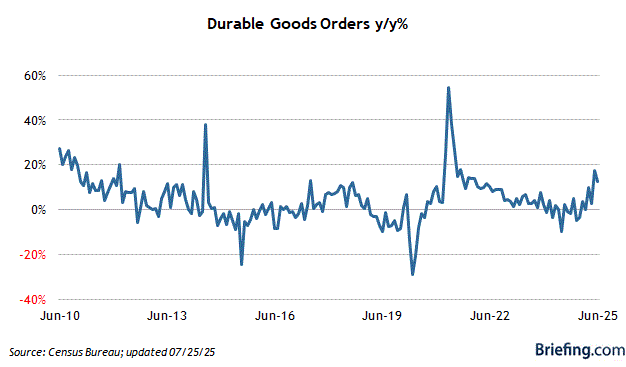
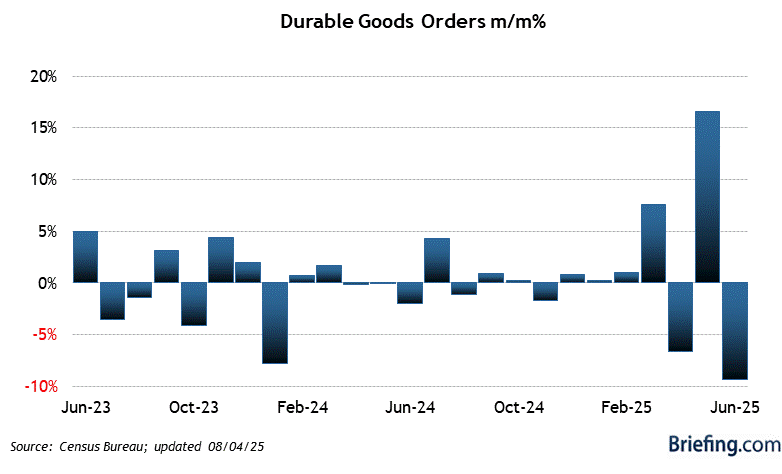
  • The advanced durable goods report would suggest that manufacturing activity is headed for a slowdown in the coming months as durable goods orders increased only 0.3% in July.
  • The Briefing.com consensus expected orders to increase 3.0%.
  • Orders excluding transportation fell 3.8%, well below the consensus forecast of 0.5% growth.

Key Factors

  • Volatility in aircraft orders over the past several months has made movements in durable goods orders difficult to track, and July proved no different. After declining 25.3% in June, aircraft orders increased 75.9% in July. The jump in demand for aircraft kept the headline orders growth level in the black.
  • Excluding transportation, the growth pattern in production has been much more stable since October 2009. Since then, manufacturing orders have fallen in the first month of the quarter before rebounding during the next two months.
  • This pattern held in July.
  • The only difference this month from the previous quarterly trends was the size of the drop. Orders fell at the fastest rate since January 2009 and it would take a much more sizable increase in orders over the next two months to pull it back into positive territory for the quarter.
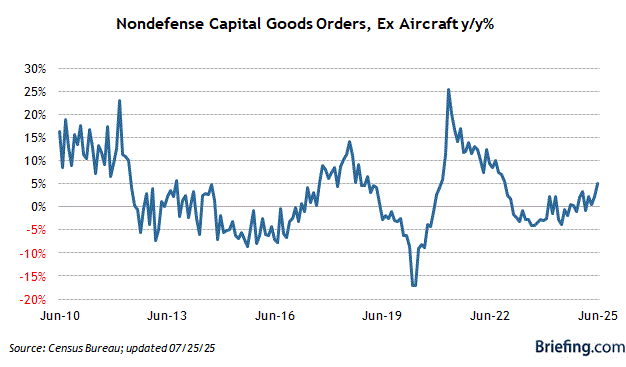
  • Business investment has also followed this trend since October.  In July nondefense capital goods orders excluding aircraft fell 8.0%. We expect orders to rebound next month.
  • Shipments of nondefense capital goods excluding aircraft were revised up from 0.5% to 1.0% in June. This should give a slight positive bump to the second quarter GDP revisions.

Big Picture

  • Durable goods order trends have been extremely postive since late 2009. That reflected a revival in consumer demand and lofty expectations for continued consumption growth. While bank credit remains tight, large firms have been able to take advantage of low yields by issuing their own debt for capital purchases.

Category JUL JUN MAY APR MAR
Total Durable Orders 0.3% -0.1% -0.7% 2.9% 0.1%
    Less Defense 0.3% 0.2% -0.6% 3.4% 0.0%
    Less Transport -3.8% 0.2% 1.4% -0.9% 4.9%
    Transportation 13.1% -1.1% -6.6% 15.4% -13.2%
  Capital Goods -2.7% 0.2% -0.8% 6.3% -5.7%
  Nondefense -2.8% 1.2% -0.4% 8.1% -6.7%
    Nondefense/nonaircraft (core cap gds) -8.0% 3.6% 4.7% -2.8% 6.7%
  Defense Cap Goods -2.2% -5.6% -3.4% -3.1% 0.0%


Monday, August 23, 2010

S&P 500 Index Dividend Yield vs 10y Bond Yield, PE vs Interest Rate

Not Bull, Not Bear: Meet the Wolf Market

By KRISTINA PETERSON

'A wolf is clearly a smaller animal than a bull or a bear,' said phrase coiner Michael Purves, 'but it's very quick and decisive.' Here, a tame wolf in the village of Nadbiarezha, north of Minsk, Belarus

NEW YORK—Out of the quest to accurately describe hybrid concepts came the spork, brunch, pluot and mule. One investor's struggle to characterize the U.S. stock market's recent twists and turns led to new market terminology.

Welcome to the "wolf" market.

The wolf market is characterized by a tight trading range, increased volatility, high stock correlations and quick reversals, said its coiner, Michael Purves, chief global strategist and head of derivatives research at BGC Financial. Choppy trading makes it hard to pick stocks based on fundamental qualities, leaving shorter-term options and technical analysis better tools for navigating its bounces, he said.

"I was walking around the block one night and thought, you know, we need another animal," Mr. Purves said. "A wolf is clearly a smaller animal than a bull or a bear, but it's very quick and decisive."

Mr. Purves dates the start of the wolf market to late April although its origins reach further back, he said. In the rally from the March 2008 lows, investors priced in expectations of a faster recovery than has yet materialized. The market has struggled to find direction, balancing the drag from the late spring European sovereign-debt crisis and the recent slew of lackluster economic data with the more encouraging second-quarter earnings. That has left trading trapped in a tight range, subject to sharp ups and downs.

On the bearish side, Mr. Purves doubts the Standard & Poor's 500 index will be able to break above its April high of 1225 by the end of the year. But bulls can point to strong second-quarter earnings and demand from growing economies such as China, keeping a floor around 1010 in the S&P 500, he predicted. Meanwhile, the CBOE Market Volatility index, known as the market's fear gauge is likely to stay elevated between 25 and 35 for longer than normal. The VIX closed Friday at 25.49.

Of course, low volume during August trading has exacerbated market swings. Monday's trading volume was the lowest of the year and isn't likely to substantially increase until September.

"This is a market that's trying to feel its way and it's feeling its way during an extremely slow period in which many folks are out on vacation," said Robert Pavlik, chief market strategist at Banyan Partners. "We've obviously exited the recession, but people are still nervous about the conditions."

With stocks trading closely together as macroeconomic issues dominate the market, investors are relying more heavily on technical analysis, Mr. Purves said. In part, the rise of algorithmic trading already has made the market's moves more closely tied to technical triggers. Also, an environment where interest rates are close to zero makes cash-flow analysis of companies difficult.

"In the absence of something else, technicals loom larger," Mr. Purves said. He also advocates turning to options to make shorter-term bets in a murky market.

The wolf market may be here to stay, at least until the economic recovery accelerates or another catalyst prompts the market to find footing. Mr. Purves believes the wolf market will last into 2011.

"It's going to take a long time to reverse to a classic economic cycle," he said.

Write to Kristina Peterson at kristina.peterson@dowjones.com

Credit-Card Rates Climb

Levels Hit Nine-Year High as New Rules Limiting Penalty Fees Help Fuel Rise

By RUTH SIMON

Interest rates continue to tumble for the U.S. Treasury, companies and home buyers alike. But for a large portion of 381 million U.S. credit-card accounts, borrowing rates have been moving only one way: up.

New credit-card rules that took effect Sunday limit banks' ability to charge penalty fees. They come on top of rule changes earlier this year restricting issuers' ability to adjust rates on the fly. Issuers responded by pushing card rates to their highest level in nine years.

In the second quarter, the average interest rate on existing cards reached 14.7%, up from 13.1% a year earlier, according to research firm Synovate, a unit of Aegis Group PLC. That was the highest level since 2001.

Those figures look especially stark when measuring the gap between the prime rate—the benchmark against which card rates are set—and average credit-card rates. The current difference of 11.45 percentage points is the largest in at least 22 years, Synovate estimates.

By comparison, the spread between 10-year Treasurys and a standard 30-year fixed-rate mortgage is just 1.93 percentage points, near historical averages, according to mortgage-data provider HSH Associates.

The moves are driven by a combination of forces. The Credit Card Accountability Responsibility and Disclosure Act of 2009 has given card issuers less flexibility to raise interest rates as they wish. At the same time, issuers are still dealing with credit-card delinquencies that remain above historical levels.
Experience WSJ professional
Editors' Deep Dive: Credit-Card Firms Move Beyond New Rules

*
CARDLINE
Merchants Expected to Push Cheaper Payments
*
Dow Jones News Service
Delinquencies Fall to Lowest Levels of the Year
*
Collections and Credit Risk
Card Issuers On the Hunt

Access thousands of business sources not available on the free web. Learn More

"The rules have changed and the goalposts of risk have changed," says Paul Galant, chief executive of Citigroup Inc.'s Citi Cards unit.

Banks used to boost rates in a hurry on borrowers who fell behind on payments or otherwise turned out to be surprisingly risky. However, under the Card Act, financial institutions must warn customers at least 45 days before making substantial changes to rates or fees. People can avoid future rate increases and pay off existing balances over time.

As a result, most changes affect only new credit-card purchases. New rules that took effect Sunday limit what banks can collect in penalty fees, too.

Now bank executives say they need to be smarter when setting the initial interest rates on credit cards. In many cases, that means starting off with a higher rate. "We can't come up with penalty pricing or if we can, quite frankly, it's too late to do much good," says Stephanie Keire, head of consumer credit-card risk management at Wells Fargo & Co.

The sponsor of the Card Act, Rep. Carolyn Maloney (D-NY), said that despite the rising rates, the law benefits consumers because it eliminates unwelcome surprises and provides them with a clear picture of the costs they will face. "Better that consumers should know up-front what the interest rate is, even if it's higher, than to be soaked on the back-end by tricks and hidden fees."

At Discover Financial Services, a diminished ability to boost rates is causing the Riverwoods, Ill., company to offer fewer interest-free balance transfers for new customers, says Discover President Roger Hochschild. Balance transfers have declined 60% from last year. A typical offer might include 0% interest on the transferred amount for a year, with customers paying a balance transfer fee.

More increases are looming as card issuers respond to the new penalty-fee limits, says Ken Paterson, vice president of research at Mercator Advisory Group.

Many banks rushed to boost rates before limits on increases for existing customers took hold in February. Some lenders have recently raised rates for new borrowers. For example, Capital One Financial Corp. in June increased the rate on its Classic Platinum for Young Adults card by 2.9 percentage points from the previous 16.9%, and increased the rate on its No-Hassle Cash Rewards card by 1.9 percentage points.

In May, Wells Fargo & Co. increased the interest rate on new Cash Back Home Rebate, Platinum and College cards by one percentage point. Citigroup boosted the minimum rate on its Platinum elect card by two percentage points in July. The higher rates apply to new accounts.

Besides raising, rates, increasingly stingy lenders are revamping some of their underwriting techniques. Banks are relying more heavily on what is known as trend analysis to determine which borrowers are showing signs of improvement or weakness in their financial condition, says Steven Wagner, president of Experian PLC's Consumer Information Services unit.

A credit-card applicant might be considered too risky if he used much of his existing credit in recent months. That could increase the chances that the borrower might be denied a new card or charged a higher rate.

Some issuers want to better use their data on existing customers. Bank of America Corp. says its move in March to merge its deposit-gathering and credit-card units was aimed partly at weighing existing relationships with the Charlotte, N.C., company more heavily in credit decisions.

Bank of America now is more likely to offer customers with large deposits at the bank a lower rate, higher credit limit or better rewards than similar borrowers it knows less about.

View Full Image
0822creditcard
Getty Images

New credit-card rules that took effect Sunday limit banks' ability to charge penalty fees. Above, a woman uses a credit card to pay for fuel.
0822creditcard
0822creditcard

Meanwhile, lenders are quicker to reduce credit lines at the first signs of financial stress, including late payments on other bills, a pay cut and unemployment. Several large U.S. banks have begun parsing employment and income data for changes that could affect the riskiness of existing customers, says John Cullerton, vice president at Equifax Inc. He declined to name the lenders.

In an effort to better manage risk, card issuers are handing out less credit, too. The credit limit on new bank cards averaged $3,923 in May, the latest month for which data are available, according to Equifax. That is down 11% from an average of $4,422 a year earlier.
More

* Earlier: The New Credit-Card Tricks

Rising interest rates on many credit cards won't necessarily lead to more profits for issuers. "The interest-rate increases are designed to improve and protect profitability," says John Grund, a partner with First Annapolis Consulting Inc., but stubbornly high delinquencies and Card Act curbs will eat into those gains, at least in the short term.

Most cards now carry variable rates, meaning any increase in the prime rate is likely to be quickly passed along to borrowers. "Consumers will end up getting squeezed" when the Federal Reserve begins to raise rates as the economy recovers, says Ben Woolsey, director of marketing and consumer research at CreditCards.com.

Still, some bank executives say the interest-rate trend is likely to reverse as the U.S. economy recovers. "This is a very competitive industry," says Kenneth Clayton, senior vice president at the American Bankers Association, a trade group. "Somebody will take advantage of lower defaults to drive prices down."

Write to Ruth Simon at ruth.simon@wsj.com