Monday, March 10, 2014

Evidence For And Against A Biotech Bubble

Summary
  • Talk of a biotech bubble is ramping up.
  • Some top biotechs have struggled in recent sessions.
  • While superficial evidence of a bubble exists, I believe a deeper look at the issue reveals that such talk is premature.
With all the talk of a 'biotech bubble' lately, I think it's important to consider this possibility head on, as well as some reasons why it could be premature to come to this conclusion. The term 'bubble' implies that the sector is due for a downside correction, so it would be wise to head to the sidelines ahead of this event.
So, let's consider the evidence for and against a dreaded biotech.
First off, the sector has been on an absolute tear over the past few years, illustrated nicely by the chart below. The iShares Nasdaq Biotechnology (NASDAQ: IBB) is now up 68% within the last two years. Ok, I hate to admit it but that does scream bubble.
IBB 1 Year Total Returns Chart
If we compare the price to book value ratios of a bellwether blue chip, General Electric (NYSE: GE), to a top biotech, Gilead Sciences (NASDAQ: GILD), the picture becomes even bleaker. Essentially, investors are now paying massive premiums for even top biotechs relative to their intrinsic value, and these premiums have risen substantially over the past two years.
GILD Price to Book Value Chart
Let's now consider the biotech sector's long-term performance prior to its recent bull run. This ten year chart prior to the recent biotech explosion paints a different picture entirely. From 2001 to 2010, the sector gained a grand total of 47.8%. The one notable exception is the period between 2003-2004 that saw a steep rise in this index. Why? Because the FDA approved 36 new drug applications in the 2003-2004 timeframe.
IBB 1 Year Total Returns Chart
Besides this single year, however, new drug approvals largely stagnated within this ten year time period, as shown by the chart below.

A side by side comparison of the sector's performance and number of new drug approvals shows that biotech valuation is intrinsically tied to the amount of innovation that is ultimately translated into a commercial product. Although the FDA only approved 27 new drugs in 2013, it's important to remember that this would have been a strong year in the period from 2001-2010.
I'd also like to point out that the type of innovations coming out of the sector now are a bird of a different feather altogether. In my view, the sector has experienced an nearly unprecedented level of innovation leading to breakthrough drugs, therapies, and medical devices. And ample evidence exists that supports my view.
AbbVie (NYSE: ABBV) and Gilead Sciences, for example, have recently developed functional cures for hepatitis C. Intercept Pharmaceuticals (NASDAQ: ICPT) developed a drug, OCA, that actually reverses liver fibrosis, and looks to be a breakthrough therapy in a host of liver disorders.
I could easily go on, but the broader point is that the dramatic appreciation of the entire biotech sector isn't without merit. As such, I am hesitant to call it a bubble-yet. Yes, companies in the sector are undoubtedly trading at rich premiums, but this does reflect a boon in innovation.
Looking out into the future, I suspect that the sector will begin to level off within the next two years, as revenues catch up to stock prices. But I don't think a major correction is warranted in the true sense of a bursting bubble. Bubbles imply that the asset became irrationally and hence, dangerously, overvalued. If anything, I think the sector is projecting the steady stream of game-changing revenue generators now coming on the market, and the valuation gap isn't unreasonable.
Turning again to Gilead as a prime example, the revenue stream from Sovaldi could set the stock up to trade at a mere 6 to 7 times annual revenue at current levels. And the company has a pipeline chock full of drugs with strong commercial potential. Viewed this way, it would appear that the market has begun to price in some of Gilead's future revenues, but it's a stretch to say it's massively overvalued in the classic bubble scenario.
When bellwethers like Gilead begin to trade at 70 times annual revenues, perhaps then, we should revisit the bubble meme. In the meantime, I think it's a bad idea to get caught up in bubble hysteria. Instead, it's better to keep an eye on the pace of innovation occurring in the sector. After all, that's the true measure of how these stocks will perform over time.

Saturday, March 8, 2014

Copper Prices, ETFs See Largest Plunge Since 2011

Copper Prices, ETFs See Largest Plunge Since 2011

March 7th at 3:04pm by Max Chen
Copper exchange traded funds look tarnished, with copper futures experiencing their worst daily decline in over two years on fears that China, the world’s largest consumer of industrial metals, will cut demand.
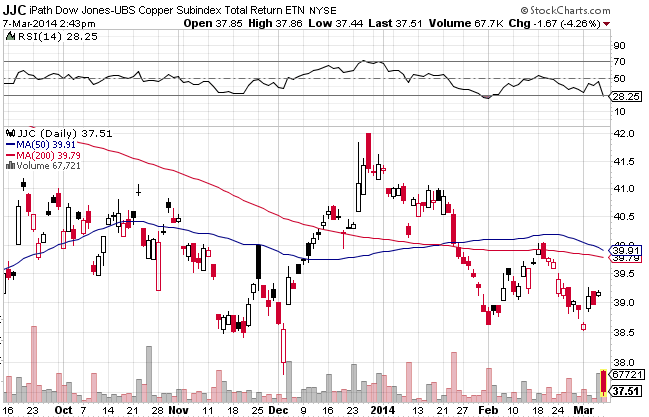
The iPath Dow Jones-UBS Copper Subindex Total Return ETN (NYSEArca:JJC) fell 4.3% Friday, while the United States Copper Index ETF (NYSEArca:CPER) declined 4.1%.
COMEX copper futures dropped 4.2% to $3.08 per pound in afternoon trading Friday, largest decrease since December 2011.
Traders are dumping copper in anticipation rising debt and slowing growth following China’s first onshore bond default as Shanghai Chaori Solar Energy Science & Technology Co. fails to repay debt, Bloomberg reports.
“You have a lot of fear in the market right now,” Tom Power, a senior market strategist at RJO Futures, said in the article. “The potential for more default is really what’s pushing the market. The market seems to be poised for another move lower.”
The default scare comes amid broader concerns about a slowdown in industrial metal demand from China, which makes up 40% of the world’s copper demand, reports Ira Iosebashvili for the Wall Street Journal. China’s manufacturing sector slowed to a seven-month low in February.
Meanwhile, China’s stockpiles grew by 4.6% to 207,320 tons this week, a 10 week high.
“Until the Chinese economy picks up and starts using up the supply that is out there, I can’t see copper trading much higher,” James Cordier, a principal at Liberty Trading Group, said in the WSJ article. “Unfortunately, there are no signs of that happening right now.”
JJC tracks the Dow Jones-UBS Copper Subindex Total Return and CPER follows the SummerHaven Copper Index Total Return. Both indices are comprised of copper futures, but JJC only tracks one futures contract while CPER spreads out holdings over two or three copper futures contracts.
iPath Dow Jones-UBS Copper Subindex Total Return ETN
For more information on copper, visit our copper category.

Friday, March 7, 2014

乌克兰“革命”将改写世界地缘政治版图(图)

乌克兰“革命”将改写世界地缘政治版图(图)

文章来源: - 新闻取自各大新闻媒体,新闻内容并不代表本网立场!
打印本新闻 (被阅读 10680 次)
在乌克兰民族主义者推翻亚努科维奇政权后,世界为之沸腾,欢呼说这是“人民的胜利”,认为“以革命推翻政权”就能带来一切。但乌克兰的民族主义者在极为短暂的革命狂欢之后,发现这场万众欢呼的“革命”终于将他们的国家带入一场前途难测的危机。

一、“革命”之药不解乌克兰之痛

革命并非医治百病之药,更何况,已经具有民主宪政形式的乌克兰面临的问题是以下几方面矛盾的纠结:

1、乌克兰在国际地缘政治的特殊处境;2、与俄罗斯之间长达数百年纠缠不清的历史恩怨;3、对外与俄的矛盾内化为本土一些俄语区俄罗斯人聚集区的矛盾。

乌克兰挣扎于俄罗斯帝国的阴影下长达数百年。苏联解体曾给了它一次重新选择的机会。保障这个机会的筹码是其在苏联解体后所继承的一笔庞大的核遗产:176 枚战略导弹和约150个核弹头,其中包括46枚新式的55-24导弹,成为仅次于美国和俄罗斯的世界第三核大国。在美俄联手软硬兼施的施压之下,出于理智 和现实利益考虑,1994年12月5日,乌克兰与美国、俄罗斯、英国签署了乌克兰加入《不扩散核武器条约》的文件,并签署《布达佩斯备忘录》,文件规定, 乌克兰承诺放弃核武器后,俄、美和英作为担保方,保证乌克兰边界和独立,不干涉乌克兰内政。

但该备忘录并不是正式条约,而是一份外交文件,外交史上也无类似先例,合法性问题非常复杂。专家表示,该条约在国际法规定下建构,但并不代表要强行执行。这次危机后乌克兰向美英求援,就是根据当年《布达佩斯备忘录》中保证乌克兰领土完整的承诺。

乌克兰的民族主义者不是成熟的政治家,他们在行动之时不可能想到,所谓革命不仅不可能解决乌克兰的问题,反而会将乌克兰拖入被肢解的局面;他们更不可能去体察,身处东西两大政治势力“板块”夹击中的乌克兰政府,很多时候并无多少主动选择权。

二、乌克兰在地缘政治中的特殊位置

乌克兰在地缘政治中的特殊位置,从它独立的那一天就如影随形地伴生出来。美苏冷战的结束,标志着以意识形态对抗为特点的冲突模式淡出了历史舞台,取而代之的是一度沉寂的地缘政治。在一个不再以意识形态划线的时代里,基于地缘的战略思考成为国家制定其国际战略的关键。

乌克兰的地理位置及其与其它权力中心(欧洲及俄罗斯)的关系决定了它的“安全课题”。作为与俄罗斯直接接壤的国家,乌克兰是俄罗斯与欧洲其它大国间的重要 缓冲国。苏联的解体给了乌克兰一个重新选择的机会,然而地理位置的不可变更性决定了乌克兰的特殊命运:一方面,它对俄罗斯的依赖是多方面的,从经济、军事 到政治,得到俄罗斯许多支持与帮助;另一方面,世界上没有免费午餐。俄罗斯需要乌克兰成为俄罗斯的安全屏障,以对抗北约东扩。当俄罗斯给予乌克兰帮助的同 时,需要乌克兰奉上“政治忠诚”,其实就是政治依附。正是这种矛盾状态,直接激发了上世纪90年代以来乌克兰民族主义的勃兴,一些有远见的政治家开始寻求 借助外部力量制衡俄罗斯,这就是乌克兰亲西方政治势力产生的背景。

始自去年11月的这一轮政治危机,引爆点就是亲俄的亚努科维奇总统拒绝与欧盟签订贸易协议。

三、克里米亚:乌克兰与俄罗斯的脐带

俄罗斯与乌克兰之间的恩怨情仇可以上溯到一千多年前。“恩情”主要表现于乌俄文化的交融,今天俄罗斯国徽上带有拜占庭文化标记的双头鹰,就是从公元9世纪的基辅罗斯——乌克兰民族的第一个国家承继来的。公元988年,弗拉基米尔大公娶拜占庭帝国的安娜公主为妻,宣布基督教为国民教育。以后,历代沙皇都以拜占庭文化的继承人自居。

两国的恨有多深?为了摆脱俄罗斯的统治,乌克兰不断反抗,从未放弃摆脱沙俄帝国的努力。1905年诺贝尔文学奖得主亨利克·显克微支的名著《火与剑》,就 是描述波兰、哥萨克、俄罗斯、土耳其人和鞑靼人(蒙古人)在乌克兰进行的数百年角力。黑海之滨的克里米亚半岛,就是乌克兰复杂历史的一个缩影,这里的历 史、民族构成、地缘政治遗产等都让当地及周边国家的领导人为之焦虑。

在克里米亚的人口构成上,俄罗斯族占58%,乌克兰族只有24%。克里米亚与乌克兰的同床异梦,在各方面都表现出来。根据乌克兰宪法,乌克兰语是唯一的官 方语言,但克里米亚政府的工作语言主要是俄语。当地人口普查中提到,77%的克里米亚居民以俄语为母语,11.4%为克里米亚鞑靼语,仅有10.1%为乌 克兰语。1995年3月,乌克兰中央政府为加强对克里米亚的控制,防止“发生原苏联很多动乱地区出现的情况”,先后废除克里来亚宪法和撤销克里米亚总统设 置,并下令将克里米亚自治共和国政府置于乌克兰中央政府的直接领导之下。

乌克兰独立后,克里米亚的亲俄倾向早就成为俄罗斯制约乌克兰的阿克琉斯之踵。2010年总统大选,亚努科维奇在克里米亚获得重大支持。本次政变发生后,很 多克里米亚人认为亚努科维奇是政变的受害者,克里米亚议会内的分离主义者试图推动脱离乌克兰的公民投票,亲俄罗斯的克里米亚新总理阿克肖诺夫则向普京求 助,请普京帮助维护和平,当地居民多数乐见俄罗斯出兵克里米亚。

四、乌克兰政变成为普京改写国际规则的借口

自普京陈兵克里米亚之后,乌克兰上空战云密布。因为俄罗斯、中国是联合国安理会常任理事国,想让安理会形成谴责俄罗斯出兵克里米亚的决议,决无可能,只能由欧美共同磋商如何“制裁”俄罗斯。

目前,俄罗斯在克里米亚半岛已派兵1.6万,普京在记者会上宣称,对乌克兰采取军事行动是“最后手段”。与此同时,欧美只能陆续宣布抵制俄罗斯的措施,包 括暂停与俄罗斯的经贸谘商及国防合作,等等。北约重要成员国英国首相府官员已经表示,英国不会军事介入乌克兰,但会透过政治及外交方式解决问题。

俄罗斯派兵占领克里米亚事件,是谋定而后动,性质有如二战时希特勒派兵占领捷克苏台德地区。俄罗斯《观点报》3月2日发表“俄罗斯王者归来:普京出兵乌克 兰彻底终结后苏联时代和单极世界”,文章称普京决定出兵乌克兰,最终将为后苏联时代和单极世界划上句号,俄罗斯恢复自己作为全球力量中心之一的地位,并认 为围绕乌克兰的大规模战争不会爆发。

应该说,这篇文章并非妄言,此时国际形势大异于1994年《布达佩斯备忘录》签订之时。普京此次出兵之前已经料定,欧盟与美国应对乌克兰危机,其行动将局 限于政治及外交手段。原因非常简单:欧盟目前面临经济困局,根本无力支付北约出动军队的昂贵军费;美国经济虽然在缓慢复苏,但因债台高筑,美国人民当中超 过一半希望美国政府在国际社会“少管闲事”。乌克兰是东欧国家,是欧盟东扩、扼制俄罗斯势力的“战略要地”,克里米亚被俄军占领,纯属“欧洲内部事务”, 该管的欧盟都不愿伸手,远在天边的美国又有什么理由,要将手伸进油锅中去?更何况,美国拟裁军一半,智囊们已经有人开始建议,世界要考虑进入“后美国时 代”,即美国不再为维护全球秩序提供庞大的军力。

俄中两国早就想改写国际规则,中国在东海、南海海域的频繁动作就是一种尝试,俄罗斯出兵占领克里米亚事件,是俄罗斯以强权国家的形象重回世界的开始,也是俄罗斯与中国联手改写国际规则的第一步。

Wednesday, March 5, 2014

Facebook Inc, Twitter Inc, LinkedIn Corp: Head-To-Head

Facebook Inc, Twitter Inc, LinkedIn Corp: Head-To-Head

TwitterFacebookLinkedInGoogle+Email
Facebook Inc (NASDAQ:FB), Twitter Inc (NYSE:TWTR) and LinkedIn Corp (NYSE:LNKD) are undoubtedly the world’s largest social networking platforms. Businesses are increasingly turning to social media for brand building, hiring and customer engagement. Facebook is far bigger than the other two, and has more user engagement. That doesn’t mean LinkedIn and Twitter have no growth prospects, though. Financial services firm Crisp Idea discusses each company in greater detail to identify their strengths and weaknesses.
LinkedIn Facebook

Facebook Inc (FB)

Facebook Inc (NASDAQ:FB) has overcome its biggest challenge. Not too long ago, Wall Street questioned its ability to monetize mobile users as more people started shifting from PCs to smartphones and tablets. In Q4, 2013, the Menlo Park-based company generated 53% of its total advertising revenue from mobile. It’s hard to match the might of Facebook, which boasts of more than 1.2 billion monthly active users. The recent acquisition of WhatsApp will strengthen its position in mobile advertising. The purchase has also evaded a big threat it was facing. WhatsApp had begun to overtake Facebook on mobile.
Facebook
The purchase of WhatsApp led to the depletion of cash reserves and dilution of stock. Investors have to have a bit more patience from the monetization perspective. Crisp Idea says Facebook Inc (NASDAQ:FB) offers an excellent opportunity for investors who have a three year outlook. It has a 2016 price target of $98, which is a compounded annual return of 13%.

Twitter Inc (TWTR)

Twitter Inc (NYSE:TWTR)’s story has not been as rosy as Facebook Inc (NASDAQ:FB). Crisp Idea says that the stock is overvalued with Price/Sales ratio of more than 18 times and EV/Sales ratio above 15. The current hype of social media services reaching a billion users has prompted analysts to come up with eyeball metrics that we saw during the 1999-2000 dot-com boom, which busted a few months later.
Twitter
Twitter Inc (NYSE:TWTR)’s valuation looks moderate in the context of this hype, but growth in its number of monthly active users is slowing down at an alarming rate. Twitter’s business model clearly lacks the user engagement Facebook Inc (NASDAQ:FB) provides, and the messaging communication that WhatsApp offers. Crisp Idea says Twitter will still grow on the basis of its unique business model and penetration. But even that growth doesn’t justify current valuations.
The financial services firm has a Sell rating on the stock with a 2015 price target of $45. But for long-term investors, $45 could be an attractive entry point because the growth would have overtaken valuation worries by that time.

LinkedIn Corp (LNKD)

Crisp Idea finds LinkedIn Corp (NYSE:LNKD) attractive, though its valuation is stretched. The company has a market value of about $25 billion. Its stock trades at a 16x Price to Sales multiple and a whopping 900 times Price to Earnings multiple. Another negative aspect is LinkedIn’s predatory focus on membership revenues, and its path of making the service more restrictive for those who do not upgrade memberships.
LinkedIn
However, the Mountain View-based company has a strong network of professionals, and they benefit by sticking to the website. Its positioning as a recruitment ground could be broadened in the future. Crisp Idea says LinkedIn Corp (NYSE:LNKD) has the potential to become a trusted sales channel in the enterprise and SMB sales space. The company can also monetize its user base by launching new services with a variety of partners. Crisp Idea has a 2016 price target of $550, representing a 26% CAGR on current price.

Tuesday, March 4, 2014

How To Invest In Biotech

How To Invest In Biotech

Disclosure: I own AMGN and GILD stocks
Biotech stocks have been getting a great deal of attention on Wall Street in the last twelve months, with the SPDR S&P Biotech ETF (NYSE: XBI) outperforming the NASDAQ market by a big margin. Intercept Pharmaceuticals ICPT +5.5% is up more than 13-Fold from its 52-Week lows.
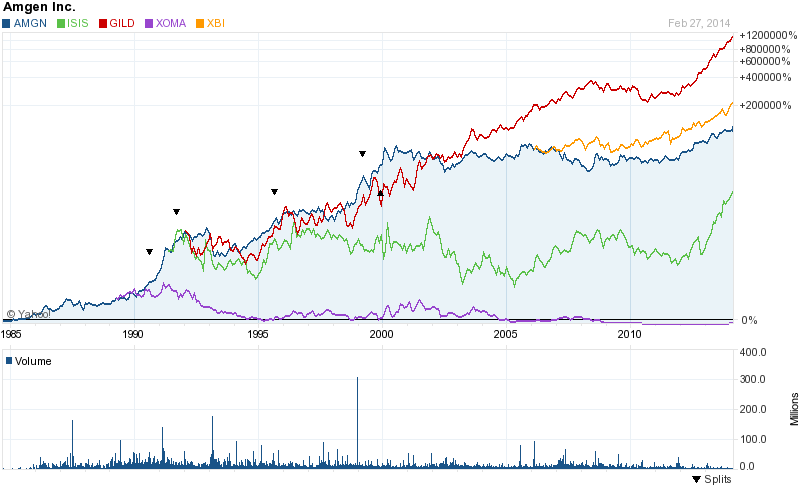
For investors who have been around Wall Street long enough, such phenomenal gains invoke memories of the biotech bubble of the 1980s, which was fueled by FDA approval of several blockbuster drugs —  including Amgen's AMGN +1.8%  Epogen and Aranesp anemia drugs.
Since then, very few biotechnology companies have followed Amgen’s success winning FDA approval for their own blockbuster drugs.
But one of these companies is Gilead Sciences GILD +1.87%, which developed Stribild, Complera/Eviplera, Atripla, Truvada, Viread, Emtriva, Tybost, and Vitekta for the treatment of human immunodeficiency virus (HIV) infection in adults; and Sovaldi, Viread, and Hepsera products for the treatment of liver disease.
That’s why Gilead’s stock caught up and eventually surpassed Amgen’s. Other companies like Isis Pharmaceuticals have been struggling for years to catch up; or remain underwater like Xoma Corporation.
A third group managed to get FDA approval for its drugs, but failed to market them effectively (e.g.,Dendreon and Affymax AFFY NaN%).
A fourth group–the largest by far–has failed to produce any successful drug, leaving investors holding the bag.
These observations point to the difficulties of picking winners in the biotechnology industry.
What are the strategies?
A conservative strategy is to stay with established biotechnology companies like Amgen and Gilead Science, with sound financials. Both companies trade at a reasonable PE while enjoying hefty operating margins and revenue growth rates.
CompanyForward PEOperating MarginsQtrly Revenue Growth (yoy)Qtrly Earnings Growth (yoy)
Amgen14.2632.46%13.30%29.60%
Gilead Sciences14.6040.3920.503.80
Source: Yahoo.Finance.com
Another conservative strategy is to buy into a biotechnology fund like SPDR S&P Biotech ETF (NYSE:XBI), which tracks the performance of the S&P Biotechnology Select Industry Index. With this strategy, you must keep an eye on the industry, rather than company fundamentals, which are promising — given the proliferation of new technologies that speed up the R&D process, and the aging of the US world population, which fuels the demand for new drugs.
Now, a speculative strategy. Try to pick up winners among biotechnology start-ups.
I usually apply two criteria. First, look for companies with drugs treating rare and devastating diseases, being in stage II or III of testing.
Second, look at companies that have received recent FDA approval for one of their drugs — though I wait for a correction before I buy.
And I spread my bets to several stocks.

One of the companies that seems to satisfy my criteria is Intercept Technologies. The company’s liver-disease drug, called obeticholic acid, or OCA, has performed unexpectedly well in a clinical trial.
These results may win the company an expedient FDA approval. But as history shows, the road may be bumpy. The problem is, in this case, that the stock has already reached a valuation of close to $8 billion.
But does the potential market for a drug justify the company’s current valuation?
ICPT key statistic11s
Market cap (intraday)7.94B
Shares Outstanding19.34M
%Held by insiders42.7%
%Held by institutions26.10%
Revenue1.62M
Operating Cash Flow-21.87M
Source:Yahoo.Finance.com3/2/14
Obviously, investors chasing after Intercept Technologies’s shares think so.
As I wrote in a previous piece, I would be skeptical, for a number of reasons:
First, we are talking about a drug that performed well in a statistical trial, not a drug that has already received FDA approval.
Second, even if OCA receives an expedient FDA approval, marketing success is no guarantee. Investors have to look no further than the fate of Dendreon’s drug PROVENGE, which received FDA approval a few years ago.
Third, even if OCA passes both the FDA and a market test, at the current valuation, the company is valued at 10 percent of the value of Amgen Inc., which has been around for more than three decades and has several blockbuster stocks in the market.
Investors who have been around Wall Street long enough remember EntreMed Inc., another biotechnology company that displayed a similar performance in a short period.
We all know what happened in that case.
The bottom line: Investing in biotechnology stocks is a tricky business, especially when it comes to picking up winners among smaller biotechnology companies without a product in the market.
That’s why this strategy is for aggressive investors only.

Monday, March 3, 2014

从模式到团队,看唯品会何以一年股价翻6倍?20 倍现在

从模式到团队,看唯品会何以一年股价翻6倍?

来源:虎嗅网   作者:虎嗅    
内容导读:投资人都爱谈模式。然而,在唯品会董事长沈亚眼中,模式并不是最核心的东西。此前,他在接受媒体采访时曾坦然谈到,“模式是可以复制的”。

让我们先看一张唯品会(VIPS)最近一年来股价的走势。
就是这:
\支撑股价持续上升的是唯品会实在的利润。唯品会于今年2月下旬公布的2012年第四季度业绩表示,其当季净营收为2.996亿美元,比去年同期增长184.8%;归属于普通股股东的净利润为630万美元,而去年同期归属于普通股股东的净亏损为6350万美元。一举扭亏。
针对此,最近,《创业邦》杂志写了一篇报道,主要通过对唯品会两位投资人的采访,来分析唯品会的商业模式以及这家公司何以能在电商哀鸿遍野的当下,一枝独秀。
我们来看下。
先看对商业模式的分析:
DCM风险投资董事、唯品会投资人曾振宇认为,决定电商能否盈利是几个关键因素:订单金额和毛利率、物流费用、市场费用。
而唯品会的商业模式——重复购买率高,使这几个因素能呈现出健康良性状态。
他说:
唯品会是一家卖fashion的电商。唯品会的商业模式是名品限时特卖,卖的都是消费者所熟知的品牌,其模式本身对消费者吸引力非常大。
重复购买率是唯品会的一大优势。也是唯品会的核心竞争力之一。在买进用户时,唯品会花的费用和其它电商差别不大,但不同的是唯品会能留住这些新用户。成本控制上,唯品会一直都在下降,市场费用这块是持续走低的,这个从唯品会的第四季度财报可以看出来。走低的原因是其重复购买率比较高。另外,物流这块是也是持续走低的,因为唯品会一直在优化。毛利率也在持续提升,这在四季度的财报上也有反映。毛利提升的原因有多种,一方面是客户购买频次的增加,另一方面是由于销量的增加,唯品会和品牌厂商的议价能力在增加。
简单来说,唯品会能够盈利,本身凭借的是商业模式的优势。由于唯品会是限时特卖的模式,商品都是低折扣,定位很清楚。并且唯品会的商品并不是长期售卖,是限量的,一定程度上制造了稀缺性,商品本身有吸引力。
投资人都爱谈模式。然而,在唯品会董事长沈亚眼中,模式并不是最核心的东西。此前,他在接受媒体采访时曾坦然谈到,“模式是可以复制的”,但是唯品会的优势在于:“我们做到这个阶段已经比较大了,5000多人都在做这个事情,如果从头开始复制需要时间。对消费者而言,我们已经建立起了品牌效应,还有同品牌商的良好关系也不是新进入者能够立刻建立起来的。”
那么再看下唯品会的个别情况。
唯品会另一位投资人——红杉资本中国基金董事总经理、唯品会董事刘星相对深入地分析了唯品会的个例与团队情况。
首先,唯品会驾驭商品的能力比较强,而该能力来自于一个由资深人士组成的买手团队:
唯品会有专门的买手团队,目前有250多人,这块是唯品会的核心竞争力之一。唯品会的买手团队原来都是时尚行业、零售行业、服装行业的资深人士,另外公司还有自己积累的大量销售数据。在这样的基础上,一方面靠买手的经验,一方面靠数据分析,在这两者叠加后,才可以决定明天的活动销售什么品类、什么品牌、什么商品。到最后都是一种组合,每一天都是不一样的、动态的。组合是有讲究的,这就是唯品会merchandising的核心竞争力所在。
其次,《创业邦》分析,唯品会另一块较强的能力是“仓储的动态运营能力”。
由于做的是限时特卖,SKU的变化是相当快的。这就对仓储的管理提出了较高的要求,从IT系统到货物的分拣,再到最终与供应商的货款对账。据唯品会的一位早期投资人讲,每七天唯品会仓储中的货品就会全部更换,而京东这样的B2C要20天左右。
刘星也特别提到两位创始人沈亚与洪晓波的特质:
沈亚和洪晓波一直都是在线下做国际贸易生意的,这种经验还是很有帮助的。对电子商务来说,商业模式的基础是商务,电子只是手段。有时我会开玩笑说“你们是温州人2.0”,既有传统温州人的嗅觉和精明,又有国际视野。相对于一个IT技术男,沈亚、晓波他们更了解商业社会里的各个不同价值链之间的关系。例如唯品会有一条供应商结款时间,他们是非常干脆利落的,说好几天就是几天。
如此看下来,唯品会的时尚名品限时特卖模式,尽管在电商各种模式中体现出优质的粘住用户能力、盈利能力,但并不是说搞就能搞的。

Today's Market: Russia Impacting These Names And IPO News

The market has a lot to worry about this week as geopolitical news is at the forefront with Russian troops having moved into the Crimea region of Ukraine. Commodities are moving higher on the news, with oil and gold leading the way higher, but the general markets are getting slammed across the world on fears that Russia will not back down as they try to make a statement and could drag the situation out for weeks.
This would not be ideal for equity markets, however, we would point out that should Mr. Putin decide to draw the line at the current areas his troops have occupied, then this might be an agreeable outcome for the world. The US cannot afford a re-escalation of the Cold War and Europe cannot afford to have their energy supplies cut off by Russia.
Chart of the Day:
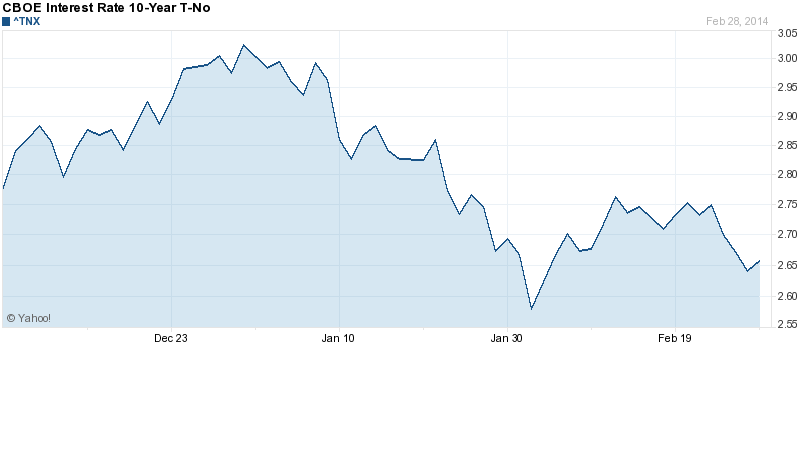
The US 10-year found support in the 2.70% range recently, but with the news out of Ukraine we have once again seen a rush to safety, pushing yields further down. We would not be buyers now, but rather sellers. Our focus is upon high quality equities, regardless of the geopolitical events surrounding Ukraine.
(click to enlarge)
Source: Yahoo Finance
We have economic news today and it is as follows:
  • Personal Income (8:30 a.m. EST): Est: 0.3% Act: 0.3%
  • Personal Spending (8:30 a.m. EST): Est: 0.1% Act: 0.4%
  • PCE Prices - Core (8:30 a.m. EST): Est: 0.1% Act: 0.1%
  • ISM Index (10:00 a.m. EST): Est: 51.6 Act: 53.2
  • Construction Spending (10:00 a.m. EST): Est: -0.1% Act: 0.1%
  • Auto Sales (2:00 p.m. EST): Est: N/A
  • Truck Sales (2:00 p.m. EST): Est: N/A
Asian markets finished mixed today:
  • All Ordinaries -- down 0.38%
  • Shanghai Composite -- up 0.92%
  • Nikkei 225 -- down 1.27%
  • NZSE 50 -- up 0.35%
  • Seoul Composite -- down 0.77%
In Europe, markets are trading lower this morning:
  • CAC 40 -- down 2.49%
  • DAX -- down 3.01%
  • FTSE 100 -- down 1.88%
  • OSE -- down 2.00%
Russian Stocks Getting Slammed
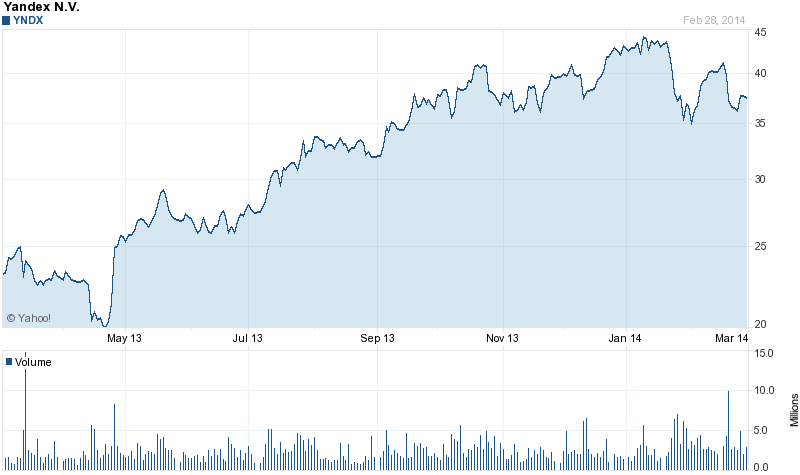
The companies taking the brunt of the hit today are those with Russian exposure, namely Yandex (YNDX), Qiwi PLC (QIWI) and VimpelCom Ltd. (VIP). All names are down over 6% as investors exit positions in order to lower their exposure to the Ukrainian situation. For those who are long-term investors and currently able to take on risk, some of these names might be quite attractive on the pullback, especially Yandex, which is Russia's top search engine and Qiwi PLC, which is the Russian equivalent to PayPal. Qiwi PLC also has a lucrative debit card business, which is slower growth than the online wallet business, but still strong with low double digit growth.
With shares falling to the $30-32/share support area, long-term investors might find this a buying opportunity. If not here, then certainly the $26-27/share area.
(click to enlarge)
Source: Yahoo Finance
The Russian ruble is trading at fresh lows versus the dollar, but this is of little concern to Putin and the Russian leaders. Speculators will move in and out of the Russian equities as they place their bets, but we would look to the currency and bond traders for guidance as to when this ordeal will be close to concluding. Those traders tend to be more on the money than equity traders when it comes to these types of situations.
Apple's New Tech
Everyone has been waiting for Apple (AAPL) to roll out its next new big idea, and CEO Tim Cook has repeatedly stated that the company has a stable of new products to release in the coming years. Our fear, however, is that most of these new products will look like CarPlay, the new technology offering that helps to further integrate Apple products into the lives of the tech savvy by simply building upon features that already existed to an extent.
We still have faith in Apple long term, and think that there is tremendous value in the company's shares, but we do think that the management team needs to fast track some of these rumored items so that the shareholders are not disappointed again this year should the company not release a product that takes it into a new market.
For the stock to move higher from these levels, Apple will have to do more in terms of hardware products and fewer products such as CarPlay.
Good News for Verifone
Shareholders in Verifone (PAY) received some good news, as it is being reported that Square has postponed its plans for an IPO. Square was at the root of some of the issues facing Verifone during its recent troubles and forced the company to focus on its more lucrative business lines, effectively beating Verifone out of the low margin and highly competitive small business market. The IPO delay seems to highlight the issues with Square's ability to grow the company as well as the size of its current revenues, which are above $100 million.
After originally being bearish on the name, we did turn bullish after the big sell-off. With the IPO of Square being postponed, we think that the name might have further upside potential.
(click to enlarge)
Source: Yahoo Finance
With one of the up-and-coming competitors now sidelined and forced to wait another year before having an IPO, it gives Verifone further time to prepare for when Square does have access to capital markets and a large stash of cash.